
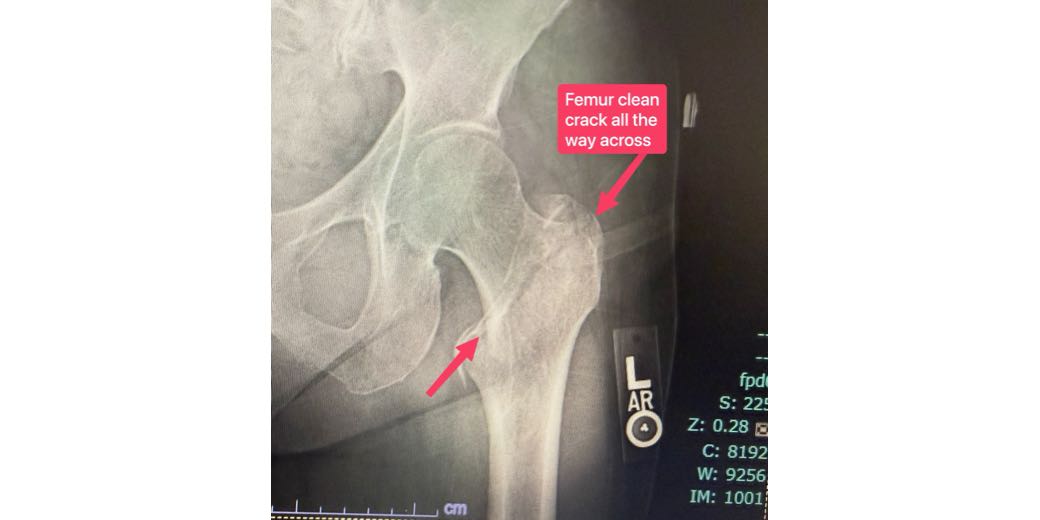
I’m not sure why, but I have always weighed myself every single day. Weighing yourself doesn’t help you lose weight. I can prove that because I tried weighing myself twice a day, and it still didn’t help, and yet I still weigh myself every day.
As a result when I went into the emergency room and they asked me how much I weighed, I promptly answered 148.1 lb. I knew it wasn’t necessary to give that extra significant digit but when you know the number it’s just natural to say it.
They evidently logged that number because when they took me into the rehab hospital, the bed was able to weigh me. The woman pointed out that somehow I had gained five pounds in just three days the hospital. I just assumed that either my scale at home or their scale of the bed was miscalibrated.
But then I got to thinking. The orthopedic surgeon put an awful lot of hardware into my bones to bolt me back together. Is it possible that at least some of the weight gain was due to the weight of that surgical stainless steel? When the rehab doctor came to see me and was looking at the X-ray, I asked him if there was any information on his screen that would tell me the length of the hardware.
He was able to dig up the exact dimensions of the hardware. First, there is a 7.157-inch-long rod inserted vertically down through my femur. Then there’s a screw that goes through that rod up at an angle to connect the ball of the femur (which is actually called the femoral head) to the vertical part of the femur, aka the femoral shaft, basically reattaching the head it where it cracked off. That screw is 3.74 in long. Finally, there is a short screw that stabilizes the rod by going horizontally into it at the bottom.
I used my favorite screenshot utility, Shotter, to measure the length of the rod in pixels in the photograph I had from the doctor of my X-ray. From that, knowing the length and the number of pixels, I could get an inches-per-pixel multiplier that I could use to figure out the true diameter of the screws and the rod.

But then I got curious about whether there were maybe standard pieces of hardware for this kind of surgery. I noticed in the X-ray it said “hip troch nail”, so I asked Perplexity to give me some information on the exact hardware that might have been used for this kind of surgery.
If I can get the diameter and length of the hardware, then I can calculate volume, and multiply that by the density of surgical steel to determine the overall weight. Sorry David, there’s gonna be math.
Perplexity first explained that the thing I’ve been calling a rod is called a TFNA, or Trochanteric Fixation Nail. We’ll call it a nail for short if that’s ok with you?
Perplexity gave me some generic information about these nails, but then suggested that I look in my medical records for the exact model that was implanted in me. I went over to My Chart, and I found the surgeon’s notes where he wrote:
Synthes 10 mm short nail, 95 mm helical blade, 34 mm distal screw
While I was a little offended that this seven-inch nail was referred to as “short”, now I had information to help Perplexity discover exactly what kind of hardware I was carrying around. I gave it the length dimension since I knew that precisely, and asked it to explain the rest.
I’ll save you from listening to the back and forth to get to the most precise answer. Together we determined it’s probably 170mm long, with the “proximal diameter” of 15.66mm (the fatter part I can see in the image) and 10mm for the distal port of the nail inside the femoral shaft. From my measurements on the X-Ray, it looks like it narrows from the thick to the thin dimension about halfway down the nail.
Ok, that’s the biggest piece, but there’s still a giant screw-looking thing that goes through the nail and into the femoral head to hold it in place while the bones heal. I learned from Perplexity that this is what the doctor referred to as the helical blade, and they’re around 10-11mm in diameter and 95mm long, just like he noted.
The little screw stabilizing the nail in the bone near the bottom must then be the distal screw. Perplexity told me it’s 5 mm in diameter and 34 mm long.
Now all I need to do is pop open Excel and get to work. I was a mechanical engineer, and for some reason, the density of steel stuck in my brain: 0.28 lbs/in³. I’ll have to convert between metric and freedom units, but that won’t be too hard.
To calculate the weight, we need the volume times the density, and to calculate the volume, we need the cross-sectional area of each nail, helical blade, and screw times the length. The area of a circle is pretty easy — I’m betting you remember it’s πR². Oh no – we’ll have to calculate the radius by dividing the diameter in half!
Weight = π x (D/2) ² x L x density
After converting to freedom units, the total weight of all the hardware is a measly .56 lbs. After I did the calculations, Steve pointed out that when they put the hardware in, they had to have removed the equivalent bone volume. Dagnabbit, he’s right. Back to Perplexity, where I found that the femoral bone density is around 0.07 pounds per cubic inch. Removing the equivalent weight for the bone, and the grand total for how much weight I should have gained was 0.42 pounds.
| Component | Diameter | Length | Volume | Steel Density | Weight | Bone Density | Weight removal |
|---|---|---|---|---|---|---|---|
| Nail (top half) | 0.617 in | 3.445 in | 1.03 in³ | 0.28 lbs/in³ | 0.29 lbs | 0.07 lbs/in³ | -0.07 lbs |
| Nail (bottom half) | 0.394 in | 3.445 in | 0.42 in³ | 0.28 lbs/in³ | 0.12 lbs | 0.07 lbs/in³ | -0.03 lbs |
| Helical blade | 0.413 in | 3.740 in | 0.50 in³ | 0.28 lbs/in³ | 0.14 lbs | 0.07 lbs/in³ | -0.04 lbs |
| Distal Screw | 0.197 in | 1.339 in | 0.04 in³ | 0.28 lbs/in³ | 0.01 lbs | 0.07 lbs/in³ | 0.00 lbs |
| 0.56 lbs | -0.14 lbs | ||||||
| Total gain | 0.42 lbs |
When I started writing this up, I had already done the calculations, but I had made a significant error in my calculations. It wasn’t an error of typing in the wrong numbers or putting the numbers in the spreadsheet incorrectly. I was using the circumference of the circle, not the area of the circle! I thought I had 4.03 lbs of hardware in me when it was only 0.42 lbs! It sure would have been a better story, right?
But wait, it gets better. I got curious about exactly how they put that nail in there and then screw those screws into place. I found a PDF instruction manual on a site that made me swear I was an orthopaedic surgeon to enter. If you like stuff like this, I put a link in the show notes to the manual, but I presume most of you do not.
The most interesting thing I learned was that they put a guide wire in first before they insert the nail, and that made me realize I had another completely incorrect assumption. The nail isn’t solid; it’s hollow.
Oh well, not all my stories are winners.