
At CES in 2025, Steve and I interviewed JW Huang, designer of iPhone (and Android) cases at TORRAS. You would think that everything that could be said about an iPhone case has already been said, but I was really impressed by JW’s description of how they build their cases for maximum protection while still being relatively sleek.
TORRAS cases feature a rotating ring on the back that pops out to allow you to have a secure handle on the phone, but also gives you a nice stand at a lot of different angles. All of the cases are also MagSafe, so you get the ring without giving up magnetic charging. I was impressed during the interview by JW’s explanation of how much testing they do on that rotating ring to ensure that it will work for the long haul.
After the interview, I bought a TORRAS Spin case for my iPhone 16 Pro and loved it!
Then Steve and I bought iPhone 17s Pro, which meant it was time for new cases. Steve bought the Cosmic Orange iPhone 17 Pro, and I bought the Deep Blue. I bought another case from TORRAS in dark blue that matched the phone perfectly. Steve went with a clear TORRAS case so the Cosmic Orange could shine through.
While the deep blue of my phone was beautiful, I could never get used to the fact that my phone was darker than Steve’s because he has always had the darker phone. I was constantly confused and looking for my phone when it was right in front of me. I went on the hunt for a different option.
The case I settled on was the TORRAS Q3 Silicone 360 Spin, in what they call ivory gold. It’s a light beige with a gold ring stand. I’ll get into the details in a moment, but the more interesting part of the story should come first.
This silicone case was absolutely delightful to the touch. It was soft and supple, with just enough friction, and I loved it! However, when we got back from Finland, I noticed that it had gotten sticky. Now I’m sure you’ve seen this happen before with silicone things, but I was really bummed that this not-inexpensive case was so icky to touch.
I remembered JW talking about how much they test their products to ensure longevity, and I thought on a lark I would try writing to the company directly. I asked them whether it was possible that the incredibly cold temperatures we had experienced in Finland were responsible for the rapid degradation of the silicone.
The response I got from TORRAS was friendly, informative, and very helpful. I began a delightful chain of emails with my new friend Jacky. Let’s start with her explanation of what probably happened to my silicone case. She wrote:
Let me sincerely explain this for you: Silicone is a porous material by nature. It can absorb oil, sweat from hands, and moisture from the air. In hot and humid environments, the silicone becomes fully saturated with these substances. When the environment changes drastically and becomes dry, the moisture trapped inside the material separates out, which causes the issue you’re seeing.
I thought that was fascinating, and I was glad to hear it wasn’t my imagination of the timing of the change in the feel of the case. Jacky explained that while regular returns and exchanges are possible for 30 days through Amazon, if you truly have a problem with a product from TORRAS as I did, their warranty is 365 days. She happily and immediately mailed me a replacement case. When it arrived, I couldn’t have been happier with that yummy soft silicone feel.
But Jacky and I didn’t end our newfound friendship there. She read that I was in Finland and asked whether I had gone to see the Northern Lights. She had done something similar recently, so we traded photos, and both enjoyed each other’s experiences. Then Jacky decided that I really should test out their newest iPhone case, the O3 Air.
TORRAS has a lot of different cases, and before talking to Jackie, I found it a little hard to figure out the feature differences between the different models. With Jacky’s help (and a handy dandy diagram she gave me for the shownotes, I know understand.
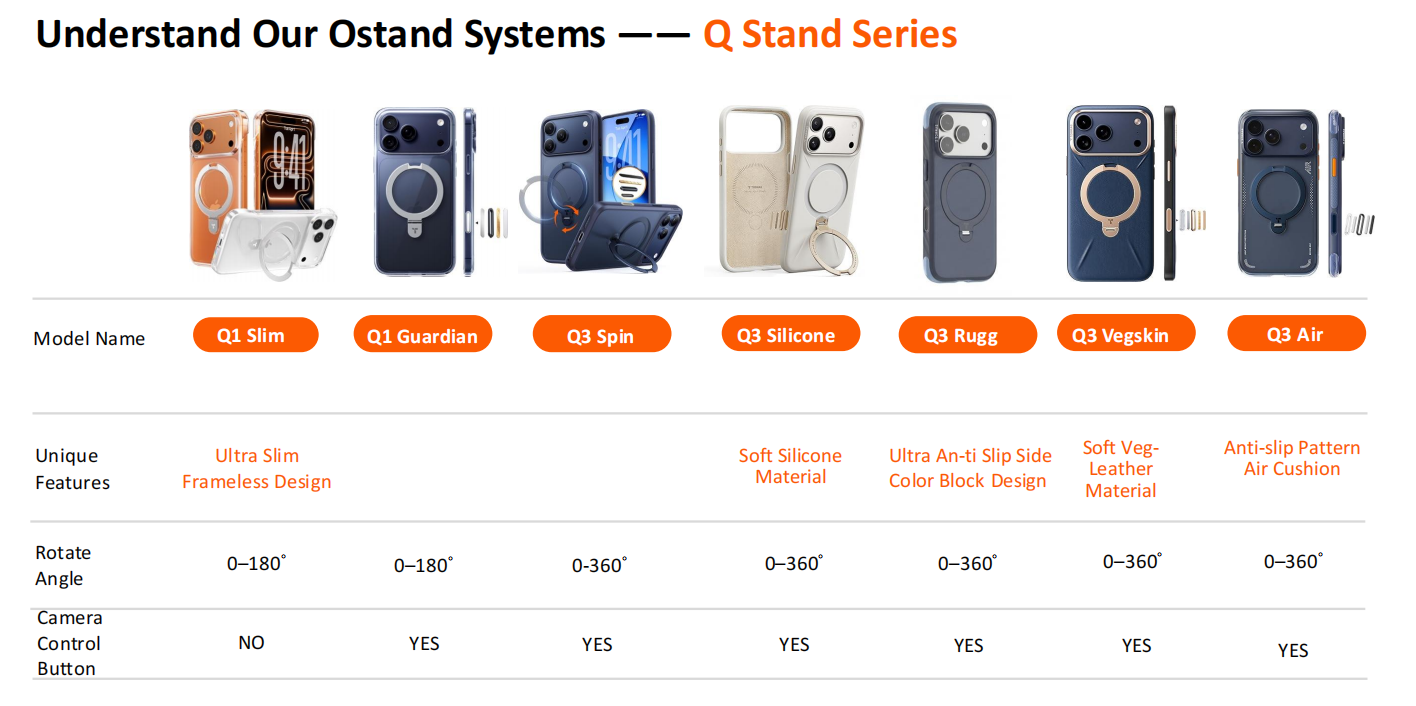
TORRAS has two series of cases: O Stand and Q Stand.
The Q Stand Series has rings that rotate out and down from the top, and then the ring swivels around that bottom connection point. This creates a relatively limited set of angles to use the ring as a stand, but in my usage, I find the Q series rings provide a more predictable user experience. With my phone in my hand, I know that the little indentation to grab the ring is always at the top. I can execute this maneuver when I’m not even looking at the back of the phone.
With most of the Q Stand Series of cases, the ring itself rotates 360° around that single pivot point, giving you a pretty good range of positions to stand up your phone.
Within the Q stand series, a couple of the options rotate only 180 degrees about that single pivot point, but the rest rotate 360 degrees. Most of them have a camera control button, but the Q1 Slim does not.
When you jump to the O Stand Series, in addition to the ring rotating around that single pivot point at the bottom of the circle, the pivot point itself also rotates 360° around the entire circle. This creates a lot of extra degrees of freedom to position the stand exactly the way you want it.
The extra degrees of freedom are nice, but in my usage, it also creates some complexity. When you’re done using the ring as a stand or a handle, and you simply slap it right back to flat, you don’t know where you’ve left the pivot point. When it comes time to open it back up, with the O Stand Series, you have to flip the phone over to find the little indentation to flip the ring back out. With the O Stand series, you always know to grab it up towards the top of the circle. As I describe this, I really do sound like a big baby that I can’t flip the phone over to look for the indentation, don’t I?!
The other thing I have found with the O Stand Series is that it is possible to rotate the ring to a position where it is in front of the camera lens. I’ve learned not to rotate it up that high when trying to take a photo, but the first time the ring was blocking the lens, I was very confused about what I was seeing!
I’m not saying everyone will be confused by the O Stand Series and its flexibility; it might just be me!
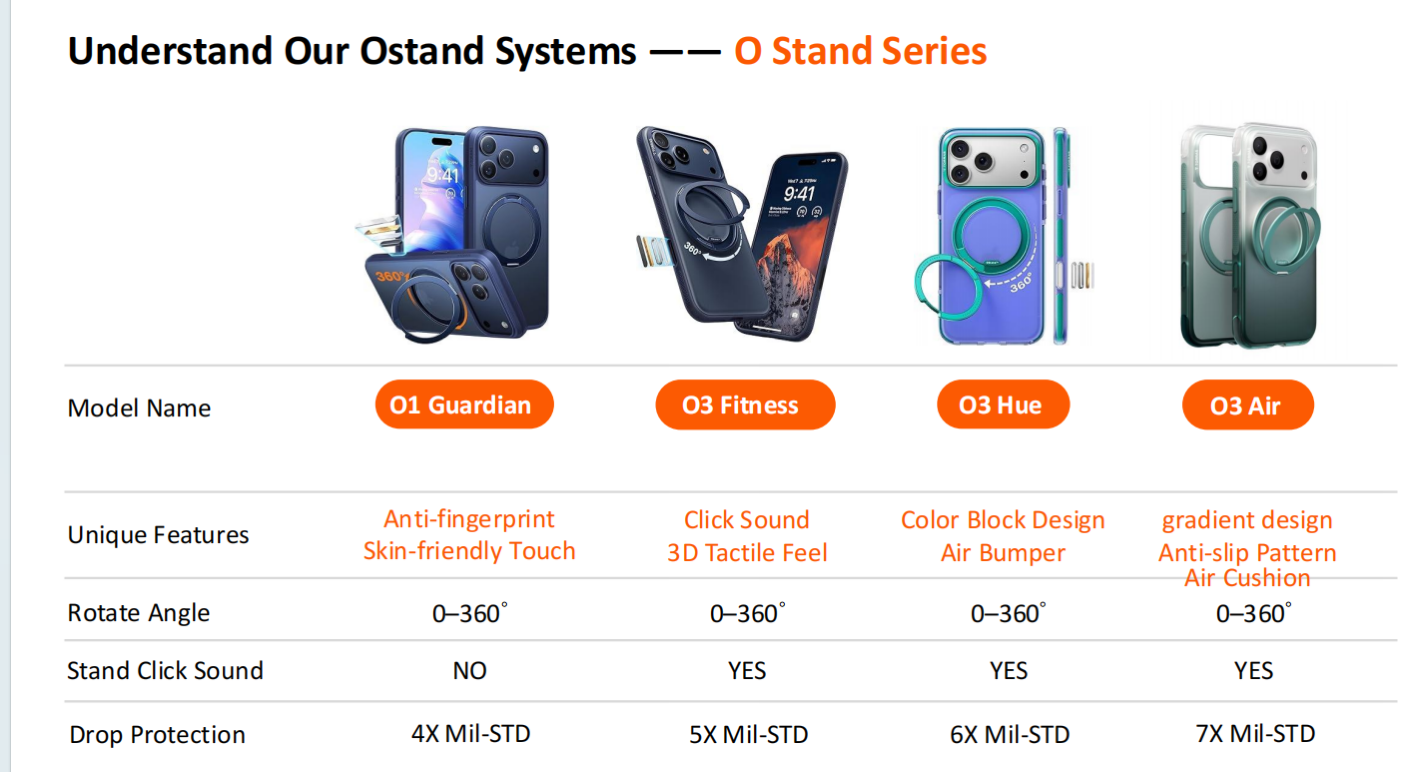
I’ve included a link to let you see the O Stand and Q Stand Series all on one page so you can compare the models.
The O Stand Series isn’t just about how the ring rotates; it’s also about protection for your phone. They have four versions of O Stand iPhone cases, and the biggest differentiator is the drop protection. On the O Stand section, they show four different models with drop protection ratings from 4 to 7 times the military standard. But they didn’t say which Military Standard. You know I couldn’t just let that ride.
I learned from Jacky that they’re referring to MIL‑STD‑810G 516.6. I’m sure you’re all familiar with this specification, but let’s refresh our memory on it.
In this 804-page specification, you’ll find Section 4.6.5 Procedure IV – Transit Drop. This section says that for “man-portable” devices under 100 lbs, and a largest dimension under 36 inches, the device should be dropped from a height of 48 inches onto 2-inch thick plywood over concrete, and that it should be dropped a total of 26 times, including on each face, edge, and corner. The device is to remain functional throughout these tests.
Since the TORRAS page on Amazon lists the newest O Stand, the O3 Air, as withstanding 7X the Military Standard, I had to ask Jacky whether that meant they dropped it 182 times, or perhaps they dropped it from 28 feet. Jacky explained that they do indeed drop it 7 x 26, or 182 times. That’s pretty crazy.
The O3 Air in Real Use
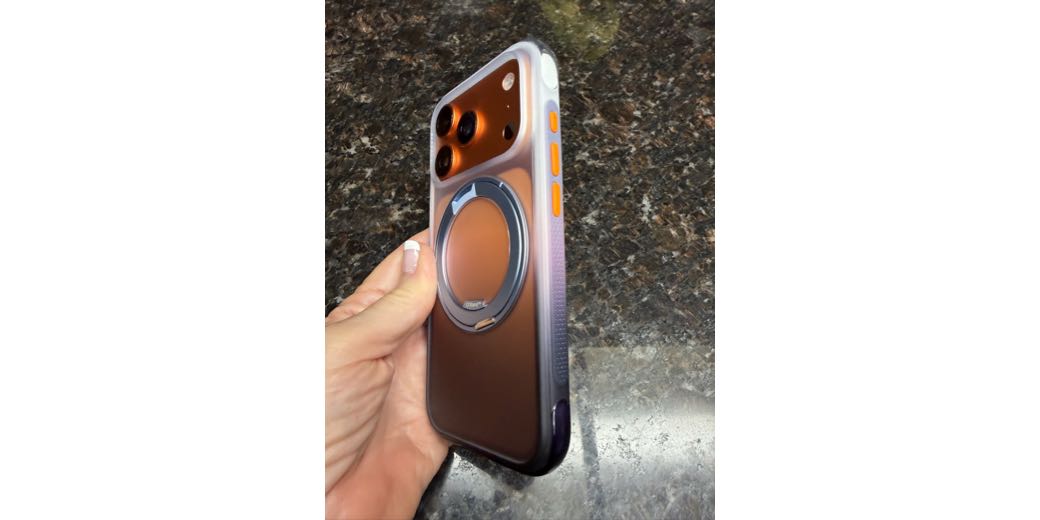
Ok, I know you’d like me to talk more about Military specs, but let’s talk about the O3 Air. You should know that TORRAS gave me two of the cases, one in Misty Fjord Blue and the second in Dusk Haze Purple.
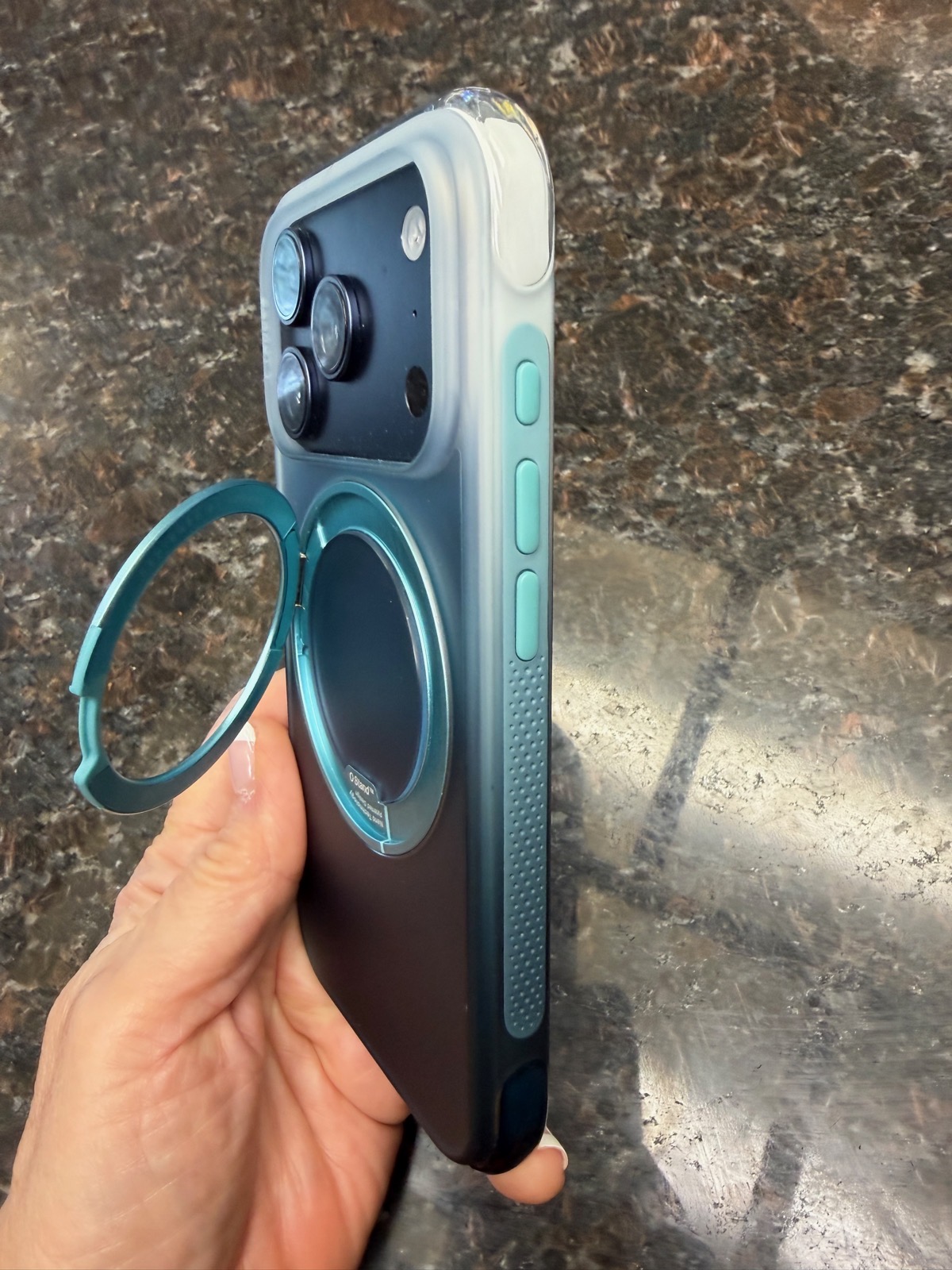
The first thing you’ll notice about the O3 Air (after you drop it 182 times) is that it has a beautiful gradient to the color. The Misty Fjord Blue is a lighter, slightly icy, translucent teal at the top, and it deepens into a darker blue‑teal toward the bottom. Jacky explained how they get this unusual gradient in a phone case:
Ordinary phone cases only require one-step dyeing, but gradient phone cases need multiple immersion dyeing processes. We also have higher requirements for controlling color accuracy to ensure the stability of the product color. After each immersion dyeing, the phone case must be thoroughly dried, and each drying process takes several days. In this way, the entire production cycle for our O3 Air gradient version reaches 30 days—that is why it is more expensive than other phone cases on the market.
You may have seen color-block designs, which are easy to implement, or use environmentally unfriendly spray painting. However, we are the first to achieve excellent gradient control and use immersion dyeing instead of spray painting to firmly lock the color.
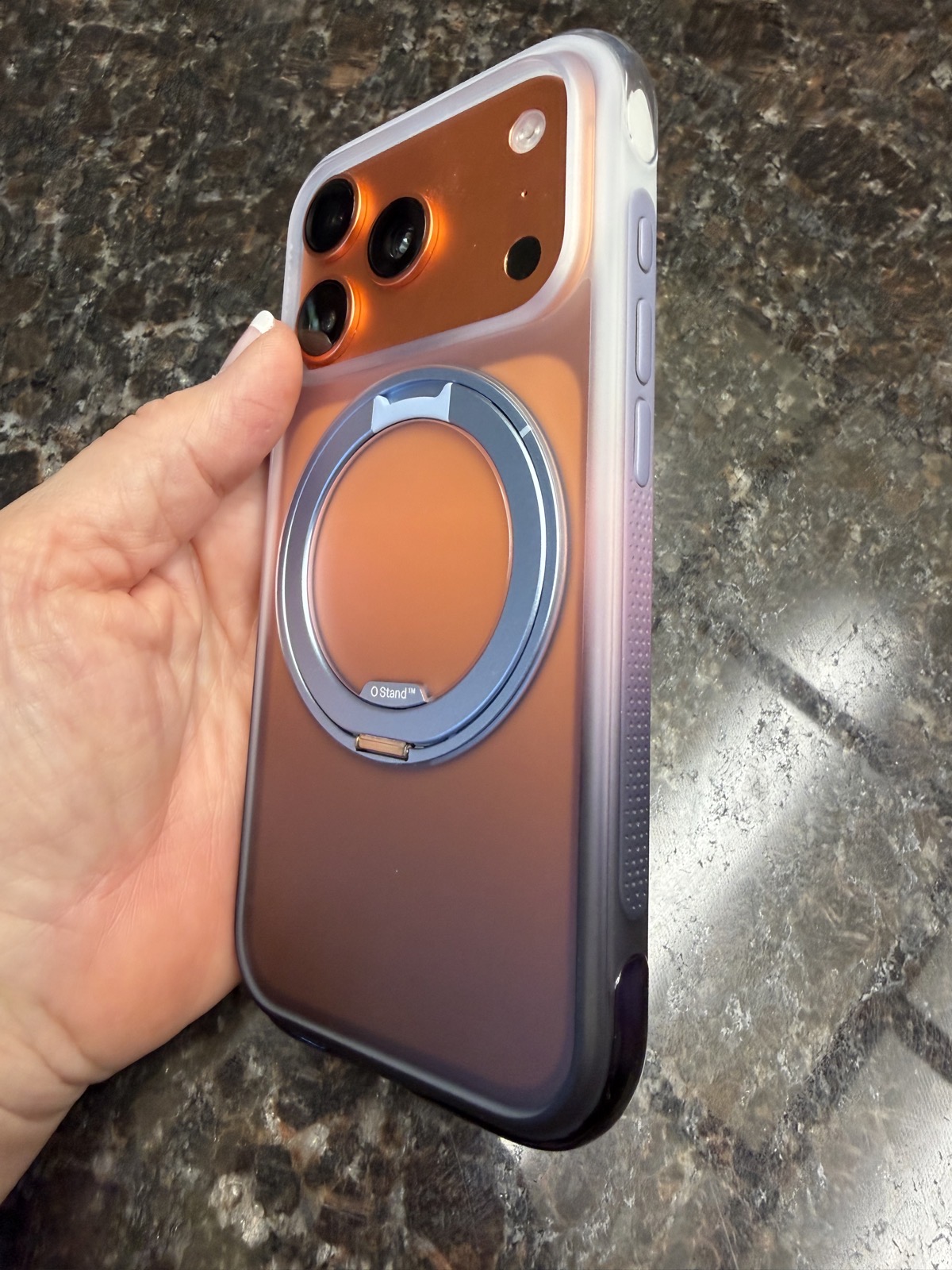
I worried how the Misty Fjord Blue case would look with a Deep Blue iPhone, but it looks fantastic. The corners look like bubbles, and they are actually air pockets. TORRAS calls these “airbags”, and it’s how they achieve the levels of military-grade drop testing success.
While visiting Steve’s parents, I used my walker to go across a very gravelly asphalt driveway. I didn’t notice that my phone was vibrating on the seat, and it vibrated all the way off onto the driveway. It landed on the back, and with the exception of a couple of very tiny scratches in the case, my phone was completely unscathed. I confess I did not test this 182 times.
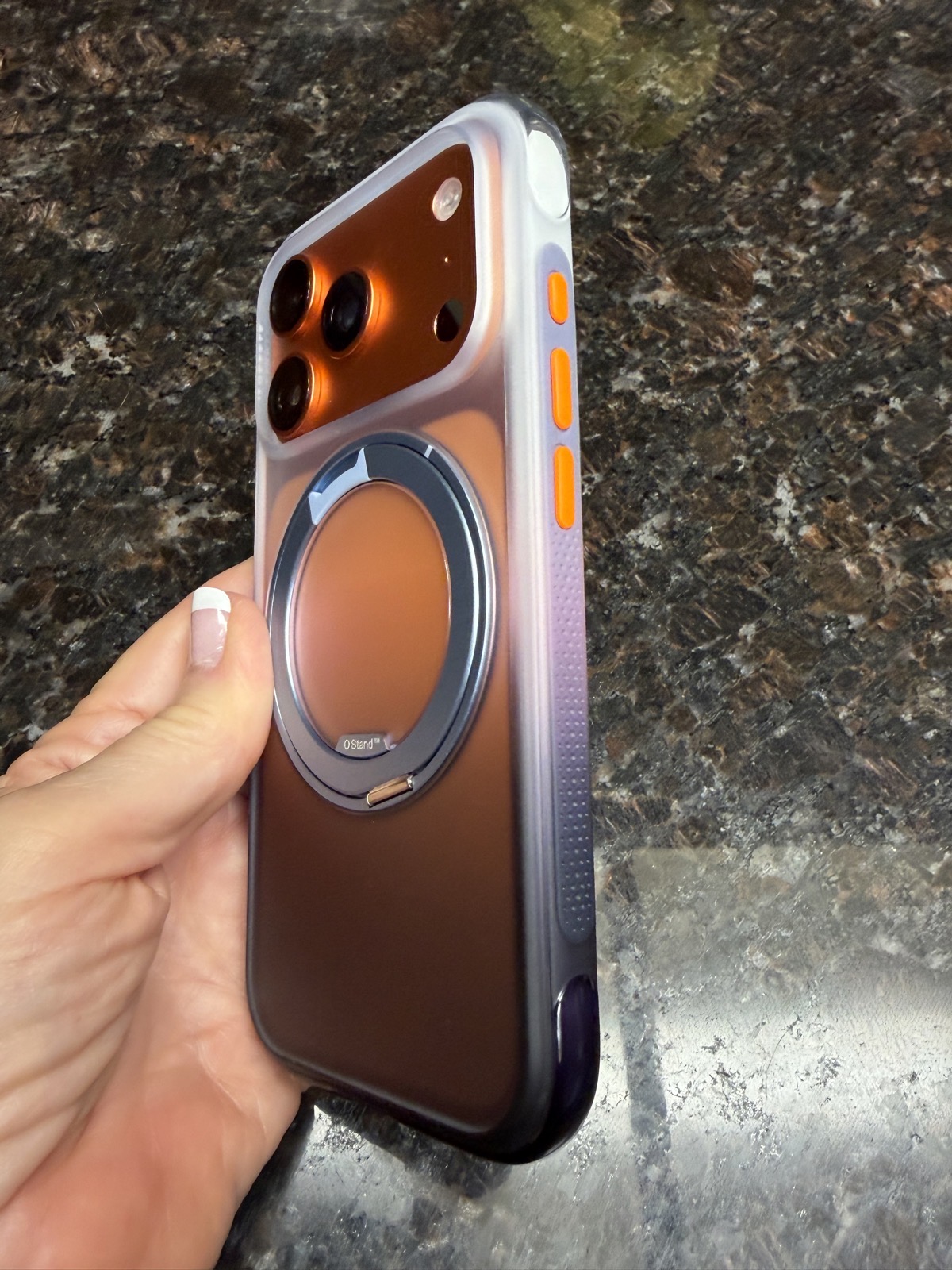
I know this is an awful lot of description for a phone case, but the O3 Air really stands out. The buttons are perfectly clickable, and are a light teal, but get this — you can pop them out and replace them with included cosmic orange buttons!
The sides of the O3 Air have a nice grippy texture, while keeping the rest of the phone slick enough to slide into a pocket.
When the Dusk Haze Purple case arrived, Steve and I took turns with the two cases, swapping them between my Deep Blue iPhone and his Cosmic Orange. Turns out the O3 Air in Dusk Haze Purple looks spectacular on the Cosmic Orange iPhone! Who would have thought? When we popped out the buttons on the Dusk Haze Purple and replaced them with the Cosmic Orange buttons, it was stunning.
Bottom Line
I’m sure you’ve guessed by now that the O3 Air from TORRAS is not inexpensive. It’s $70 on Amazon for iPhone 17 Pro and Pro Max. Even if you don’t go for the O3 Air, I highly recommend you check out all of the offerings from TORRAS on Amazon. I love the rings, I love the protection of the phone, I love the colors they have available, and I love that they stood by their product after the silly low humidity of Finland wrecked my Q3 Silicone case.