
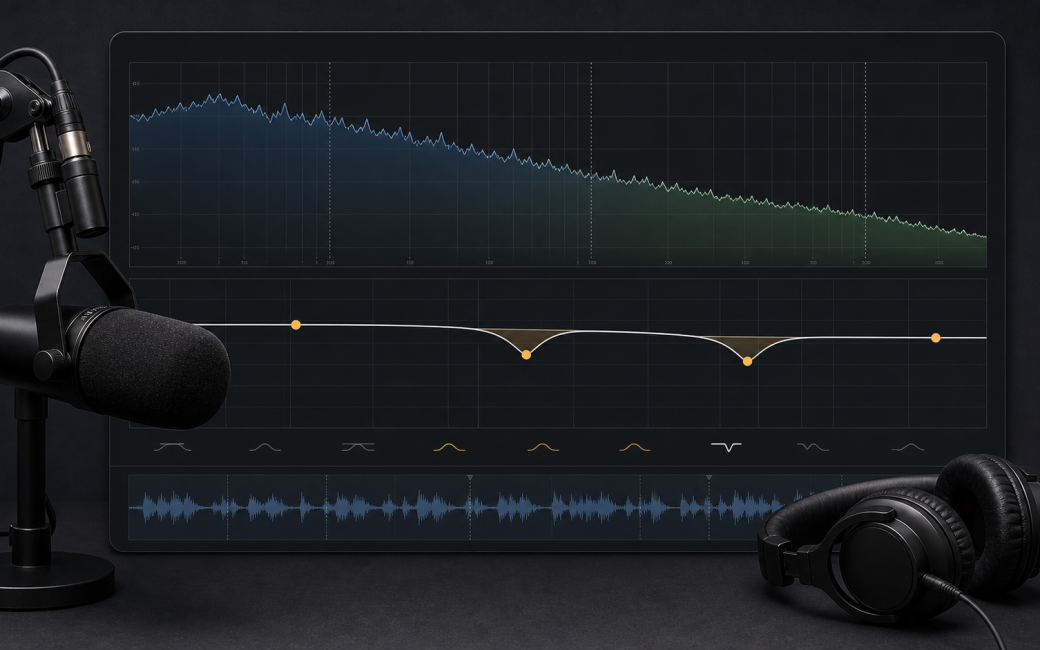
EQ got easier when I stopped asking it to do everything
I need to start this one with a confession: I used to be completely lost with EQ. Not “I am still learning” lost. I mean guesswork lost. I would watch the analyser, drag points around, do things that felt like they should be right, and then end up with a voice that sounded impressive for ten seconds and exhausting for ten minutes.
I had tin ears for EQ, so I compensated by doing more of it, which is a wonderfully efficient way to make bad decisions more confidently.
Eventually I realised the problem was not that I needed a cleverer curve. The problem was that I was trying to use EQ to solve things that should have been solved at the microphone. Once I got capture right – mic position, distance, angle, and a consistent tone – the as-recorded sound was basically already what I wanted for audiobook comfort.
Which means EQ stopped being “design my voice” and became something much smaller: remove one tiny annoyance, then get out of the way.
So, what is EQ doing when capture is already right?
If the recording already sounds like a human voice in a stable space, EQ should not be trying to reinvent it. The audiobook test is not “does it sparkle?” The audiobook test is “can someone listen for hours without their ears getting tired?” So now I treat EQ as:
- not a makeover;
- not a signature;
- not a curve I am proud of;
- just maintenance.
A small filter, maybe one small correction, and then I leave the voice alone. The funniest part is that the EQ I kept reaching for turned out to be basically one move: a gentle high-pass filter.
First, high-pass and low-pass, because the names are annoying
Since I still mix these words up sometimes, here is the simple version. “Pass” means what gets through. A high-pass filter, or HPF, lets highs pass and reduces lows. It is the “remove rumble or mud” move. A low-pass filter, or LPF, lets lows pass and reduces highs. It is the “remove hiss or soften harshness” move.
For most narration chains, if I only do one EQ move at all, it is usually a gentle high-pass filter. Sub-bass does not carry much meaning in speech, but it does eat headroom and make everything feel thicker than it needs to.
A low-pass filter is rarer for me. It can be useful if there is a specific high-frequency problem, but it is easy to overdo and make the narration feel blanketed or dull.
Here is what changed once capture was right
Once I stopped fighting the recording, something calming happened: I could bypass all EQ and still feel, yes, this is the voice. That changed the protocol.
First, I listen to the raw or dry chapter before doing anything. If it already feels comfortable, I do not go hunting for problems. Hunting for problems is a very reliable way to find some.
Second, if anything is needed, I start with a gentle high-pass filter. Not because it is trendy, but because it removes low energy that does not help intelligibility. Third, I stop early.
If I feel tempted to stack moves, I take that as a warning sign that I am back in the old world of guesswork.
At that point, the right fix is usually upstream: placement, distance, angle, consistency, or sometimes a retake.
The hard boundary is: if it takes more than a couple of gentle moves, it probably is not an EQ problem. It is a capture problem.
The useful distinction is resonances versus taste
This distinction helped me a lot. Sometimes EQ is solving a real problem. A small resonance. A bit of low-end rumble. A narrow annoyance that appears every time I lean into a phrase. That is problem-solving.
Other times, I am chasing taste. More warmth. More air. More presence. More “finished”. That is where I get into trouble, because the ten-second A/B can be very persuasive. A brighter, more produced voice can win quickly. But audiobooks are not judged in ten-second chunks.
Over time, extra brightness can make sibilance and mouth detail more obvious. Scooped mids can make the voice seem impressive but less natural. Too much low-end warmth can become a kind of slow fatigue. So I try to solve problems, not decorate the voice.
Here is the demo: no filter, gentle filter, too much EQ
The demo I would run is simple. Take a short paragraph and make three versions.
Version A: no EQ at all. Just listen for comfort. Not whether it is fancy. Whether it is listenable.
Version B: add a gentle high-pass filter. Sweep it slowly upwards until you can just start to hear the voice thinning, then back off a touch. The goal is not to change the voice. The goal is to remove low-end material that is not really speech.
And level-match when you compare, because EQ changes can trick you just by changing perceived loudness.
Version C: past-me’s mistake. Add top end. Scoop mids. Make it sound produced. It will probably win the ten-second comparison. Then listen for a minute or two and notice what happens:
- sibilance and mouth detail become more present;
- breaths and edits get more obvious;
- the voice stops feeling relaxed.
That is why audiobook EQ has to be boring to be kind.
So, where does that leave us?
The compact takeaway is:
- tone is chosen with placement;
- EQ is a nudge;
- most of the time, a gentle high-pass filter is enough;
- if I need more than a couple of moves, I should not draw harder; I should record smarter.
EQ is not where I find my voice. I found that earlier, with placement. EQ is where I remove the tiny annoyances that stop people listening for hours.
Next time, we move from making the audio sound right to making it deliverable: specs, loudness, true peak, and how to make those numbers boring.
You can find my wife’s character-driven, queer love stories at jerntonkoi.com.