
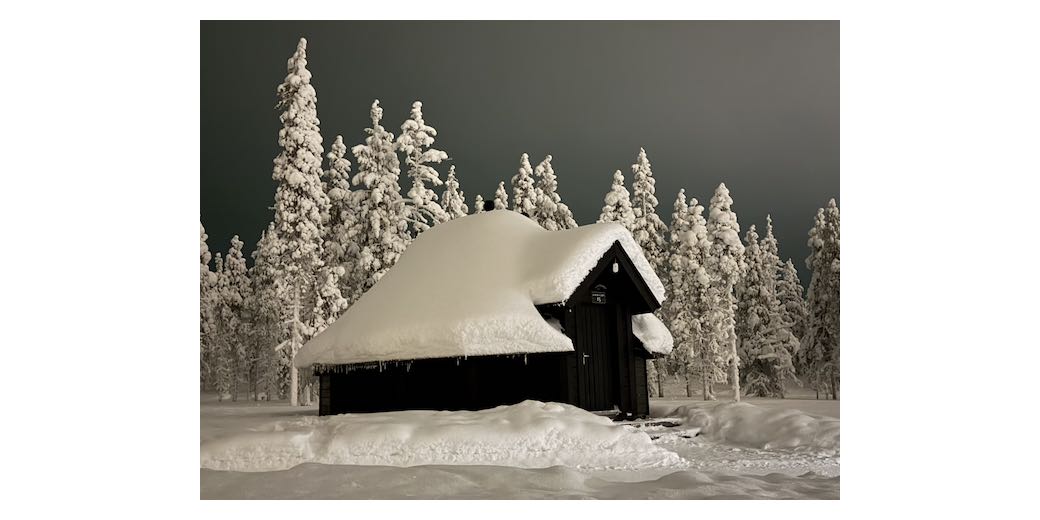
Whenever Steve and I go on our more interesting extended vacations, I like to take note of what technology challenges or cool things we discover on the trip. Steve and I just got back from 10 days in Finland and Estonia, and I have just a few things I wanted to tell you about.
eSIM
Over the years, I’ve worked hard to find the lowest cost solution to having cellular data on our trips. In ye olden days, when we used physical SIM cards, I was a big fan of Google Fi. But for our trips to four countries in Africa, and our trip to Japan, we used eSIMs from a company called GigSky. I found them through esimdb.com, and later interviewed Sam King from GigSky on Chit Chat Across the Pond. I really liked them because they were dirt cheap and worked in every country we visited, other than Zimbabwe, where no eSIMs work at all.
When we went to Japan, though, I managed to burn through my data twice over, so it didn’t turn out quite as inexpensive as I’d hoped. It was only something like $30 for 10 days, so it was still pretty inexpensive.
I liked getting a better deal than the $20/day per person for using AT&T for international data, but there are downsides. Not having your real phone number with you can cause problems. In Africa, all communications from our guides were through WhatsApp. That was all well and good, unless you didn’t already have WhatsApp enabled before you left, which is what happened to Steve. Without his phone number available, he couldn’t get the app initiated. We bit the bullet and turned it on for just a few minutes so he could play with everyone else on WhatsApp.
In planning for our latest trip, I looked at GigSky first, and for $42.69/person, we could get unlimited data in Europe, which would cover both Finland and Estonia. Our total cost would be $85.38 for the entire trip.
Steve begged me to consider using AT&T, where we’d have our real phone numbers instead of all this faffing about. I’d heard the deals were better, so I dug in to get the details. Maybe I’m the last NosillaCastaway to figure this out, but the deal isn’t nearly as bad as the $20/day per person rate we used to get.
AT&T has what they call an International Day Pass. It is automatically triggered if you’re abroad and use your phone to make or receive a phone call, and if you send a text message. It doesn’t trigger the fee if you receive a text message, which makes sense.
Now here’s the good part. It’s $12/day, not $20, and the second line to which you add an International Day Pass is only half that. So combined, Steve and I would spend $18/day to have our real phone numbers with us. The Finland trip wasn’t very long, but if you’re on a longer excursion, they stop charging you after 10 days, so 11+ days are free. I haven’t verified this, but, based on past experiences, I’m willing to bet that the 10 days is “per billing period”, so we might still be billed for more days.
The documentation confirmed that you can use your phone just as though you’re at home, so our unlimited data plan would work while on international travel. What I wasn’t able to confirm was whether we could tether to our phones. I ended up texting AT&T and got them to put it in writing that tethering was included.
At $18/day per person for AT&T’s International Data Plan, our 10-day trip would cost us $360. Comparing that to $85.38 for GigSky, AT&T would be more than 4 times as expensive.
And you know what? We went for AT&T, and throughout the entire trip, we kept noting how happy it made us to have our phones act like our real devices. We called restaurants to make reservations, we got text confirmation codes, and we used the heck out of our data plans while traveling about. Our photos synced quickly to our Shared Photo Library in iCloud, too.
Part of the joy came from really fast cellular connections in Finland and surprisingly good coverage. For a good part of the trip, we were in a region of Finland called Lapland, traveling 250 miles above the Arctic Circle, and we still had 5G cellular service. I’m talking about a 40-minute sled ride into the forest to a reindeer farm, and I was able to post a photo of a moose to social media. Truly remarkable.
Face ID, Touch ID & Passcode
Now let’s talk about a few things that didn’t work well. For some reason, I had trouble with all three methods of authentication on my iPhone and Mac: Face ID, Touch ID, and my passcode.
I can’t explain it, but while on travel, I had about a 30% chance of success with Face ID on my iPhone. I know you’re probably thinking I had on all kinds of cold-weather gear that was obstructing my face (which I did for a great deal of the time), but even a fully uncovered view of my face tended to baffle my iPhone.
What was even weirder was how my iPhone reacted to entering my eight-digit passcode. At one point, I tapped it in, and it didn’t show me the “done” button. I tried again. And again. Each time, I had no way to complete or cancel the authentication, so my only option was to lock the phone and try again. After a half-dozen attempts, I got nervous that I was going to get locked out, so I gave the phone a time-out.
I’m glad I did, because when I made a new attempt, I discovered what was happening. After tapping in say, 6 of the 8 digits, tapping in the rest of them was erasing the previous digits. The reason the “done” button wasn’t appearing was that it hadn’t received 8; it had only received 4. I tried it several times, and I saw it happen more than once. I eventually got it to accept all 8 digits, and I was able to get into my phone. The only explanation I can come up with for this aberrant behavior is that it was around -10°F when this happened, which must have caused this problem.
On my MacBook Air, I recently had the Touch ID module replaced, but it started acting up again on the trip. My fingers are normally quite dry, but a week in the Arctic made that problem even worse. I eventually erased my fingerprints and added one back in, but even to this day, I can’t use it to authenticate either to log in or get into 1Password. Not sure I can blame Finland for this, but I may have another AppleCare story to tell soon.
EU Tracking Permissions
After the European Union instituted rules that required websites to ask your permission before tracking you and selling that data, some US states also instituted this policy. While I think we can all agree that being asked permission is a good thing, I’m pretty sure all of us are weary of having to navigate those permission screens. The worst ones bury the toggles you have to flip, and you have to scroll to get to them.
I can’t empirically prove this with specific examples, but it seemed that while in Finland, the screens almost always had one button or toggle that said, “don’t track me!” I never seemed to experience any scrolling around to find the right way to make them leave me alone.
If anyone has any proof that my experience was valid, I’d be interested in hearing about your experience.
Heated Floors Are Money
When we went above the Arctic Circle, we were in a village called Saariselkä. We stayed in a little hut up in the forest with a slanted glass roof where we could lie in bed and watch the Northern Lights. You would think that we would have been quite cold in that little hut, but we discovered the joy of heated floors.
Being from sunny Southern California, we declare that we’re freezing if it dips into the 50s, so we’ve never needed such a thing. The floors of the main living area were heated, so that if we laid our socks on the ground, in the morning they would be toasty warm when we put them on. But the bathroom floor was heated even more, which made going in to take a shower absolutely delightful.
I’m sure most of you are laughing at me talking about this like discovering fire, but it was awesome.
Escalator Technology
The final technology I wanted to mention was something we discovered in our recent Japan trip. The escalators don’t run constantly at full speed with nobody on them. Instead, they’re either completely still or moving very slowly, and don’t speed up until the sensor before them is triggered by someone walking up to take a ride. Think about how much money and energy they save by this practice! And, why don’t we have this in the United States?
Bottom Line
The bottom line is that there weren’t nearly as many technical challenges on this trip, even though we were in one of the more remote parts of the world.