
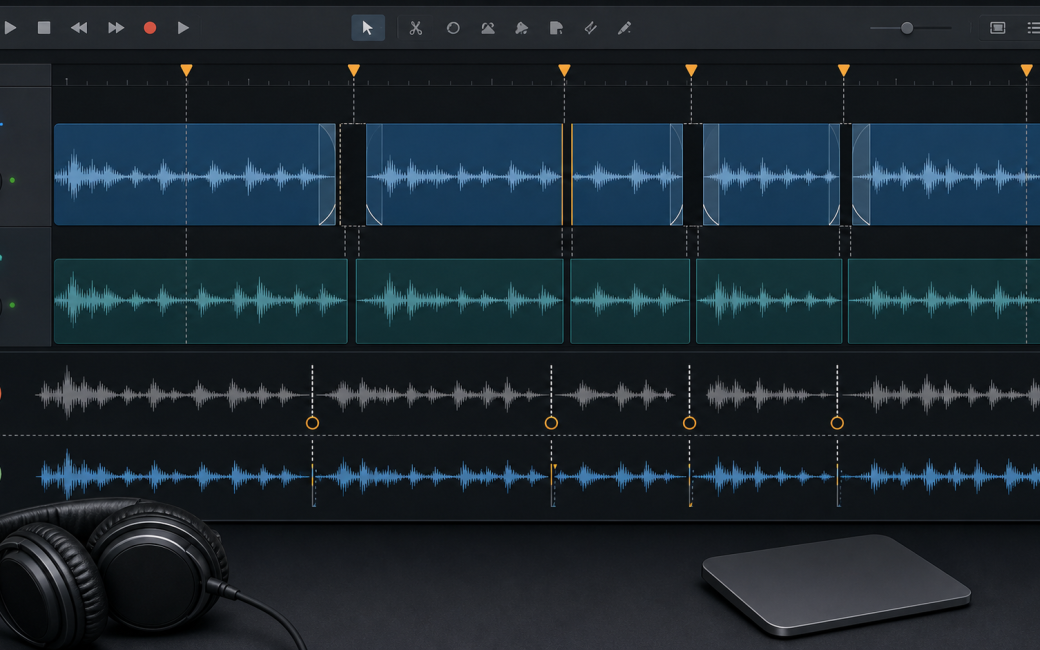
The edit that feels wrong
This part is about the kind of editing that can be technically perfect and still feel wrong. You know the feeling. The noise is gone. The cut is clean. There is no obvious click or pop.
And yet the sentence feels impatient. It feels like the narrator is rushing the listener, or like the thought did not have time to land.
That is what I mean by invisible cadence editing. The goal is not silence. The goal is meaning, because in narration, timing is not just timing. It is punctuation you cannot see.
The important thing is that meaning lives in pauses, not silence
Here is the nerdy concept, but it is basically common sense once you hear it. Our brains do not interpret speech as a flat stream of sounds. We interpret it as a stream of intentions, and a lot of that intention is carried by micro-pauses:
- the breath before an important clause;
- the tiny hang before a reveal;
- the slightly longer pause after a name;
- the thinking beat before a correction.
These pauses are rarely long. They might be a few tens or hundreds of milliseconds. But removing them can change what the sentence means.
So the point of cadence editing is not to delete space. It is to shape space so the intention remains intact.
This is also where editing speed starts to come from
The personal bit for me is that editing speed is not mainly about hotkeys. Hotkeys help, of course. But the real speed comes from rhythm.
When I have a consistent rhythm for handling breaths, pauses, mistakes, pickups, and transitions, I stop re-deciding everything. I develop a taste for what human sounds like in my material, and I repeat it.
That is what makes the edit invisible: not perfection, taste. Which is annoying, because taste is much harder to put in a checklist.
There are two failure modes I listen for
Once I can hear these clearly, I can work much faster. The first is rushed cadence: everything is clean, but the listener never gets to settle. The voice feels as if it is trying to get through the text rather than live inside it. Common causes are:
- deleting every pause after a sentence because it looks long on the waveform;
- trimming breaths too aggressively;
- removing the tiny hesitation that signals a thought turning.
The second failure mode is consonant blur. This one is not about processing. It is about cutting too close to speech.
If I cut right up to the front edge of words, I can shave off consonant onsets: T, K, P, even the start of “it”. The line starts to feel less articulate, even if I cannot immediately say why.
This is the editing version of the repair-tool problem from last time. The starts of words matter. So I want edits that keep meaning, and cuts that do not steal edges.
I use minimum silence rules so I do not negotiate with myself
They are not rigid laws, but they stop me from over-editing. Within a sentence, micro-pauses are often meaningful. I do not flatten them by default. If I tighten them, I tighten gently.
Between sentences, I usually want a little more space than I think, especially at audiobook pace. Removing too much makes the narration feel impatient.
Around breaths, I remember that breaths are phrasing. I will control loud breaths, but I am careful about deleting the pause they sit in, because that pause is often what makes the line feel natural.
You can translate this into numbers if you like, and sometimes I do use numbers just to stop myself drifting. But the better rule is perceptual: if the edit is clean but the thought does not land, I cut too much.
Then there is the question of ambience-aware fades
The other half of invisible editing is ambience. If I cut in a dead way – hard edges, mismatched room tone, sharp transitions – the listener gets that subtle edited feeling even if there is no click.
So the habit in Logic is simple: almost everything gets a fade.
Tiny fades on the ends of regions avoid little clicks. Slightly longer fades help when I am crossing between different noise or room moments. And if I have cut around a breath or a noise, I am listening for bed changes, not just silence.
In other words, I am shaping the floor as much as the voice.
So, what does the cadence pass look like in Logic?
My cadence edit pass is not an attempt to sculpt the whole chapter in one heroic sweep. It is a rhythm pass.
First, I remove obvious mistakes and false starts: the moments where I genuinely did not mean to say that. Second, and this is where Logic’s remove-silence type tools can help me get to a rough shape, I tighten long dead air: anything genuinely empty that does not serve pacing. Third, I shape pauses rather than delete them. This is the real work. If a pause feels long, I shorten it slightly and listen again rather than nuking it.
Fourth, I protect word onsets. When I cut near speech, I leave a tiny buffer. I am not trying to cut at the pixel. I am trying to avoid shaving consonants. Fifth, I check transitions. If a cut is technically clean but the sentence now feels as if it is leaning forward too hard, I put some time back.
That sounds slow, but it becomes fast once the ear knows what it is looking for. It is much quicker to make the same good decision a hundred times than to have a fresh little crisis at every pause.
Here is the demo: awkward pause, rushed versus human
This is an excellent demo because the difference is not theoretical. Take one awkward moment: a hesitation, a breath, or a long pause before a clause. Make two edits.
Version one: clean but rushed. Trim the pause until it feels tight. Make it as short as you think it can be without sounding obviously chopped. Now listen as a listener, not as an editor. Often it will feel impatient, like the narrator does not trust the listener to keep up.
Version two: human timing. Put some pause back. Not all of it. Just enough that the thought lands. Listen again.
What changes is not silence. It is intention. The second version often feels more confident, even if it is technically slower.
That is the test: cadence editing is not about speed. It is about the sentence feeling like a person said it on purpose.
So, where does that leave us?
The takeaways are simple:
- do not delete every pause; shape it;
- fade like you mean it;
- listen for rushed cadence;
- listen for consonant blur.
After a cadence pass, I listen to a few minutes at a time and ask one question: does this feel like a human thought, or like an editor pushing it along?
If the edit is clean but the sentence feels impatient, the edit is wrong.
Next time, we keep it boring again, in the best way, because once capture and cadence are right, EQ becomes much simpler: subtractive, minimal, and surprisingly effective.
You can find my wife’s character-driven, queer love stories at jerntonkoi.com.