Allison interviews Amos Miller, Founder and CEO of Guidance, about Glide, their AI-powered mobility aid designed to help people who are blind or have low vision navigate with confidence, comfort, and ease.
Glidance’s Sensible Wayfinding Service is a high-intensity computer vision and sense-making AI system built by Glidance. It connects all active Glides and powers their ability to understand complex spaces and guide you through them. It uses real-time data from an array of advanced sensors to map the best routes, identify targets of interest, and avoid obstacles to get you safely to your destination.
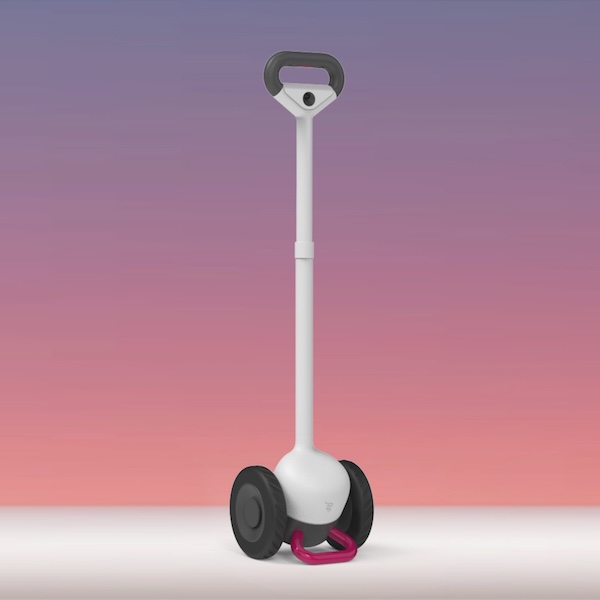
The Glide unit is comprised of a small base with two 7.5-inch side-by-side wheels that steer the device to guide you on your path. A telescoping handle extends upward from the base to a target height just below the waist. The handle can be collapsed down to 25 inches when fully compacted for easier portability when not in use. Glide can operate for 6 hours on a single charge and weighs 8 pounds.
Several sensors are built into the handle, allowing Glide to detect obstacles and determine a safe path. The handle provides haptic feedback to provide cues to the user about where to walk and how to avoid an obstacle. Also built into the unit is a speaker, microphones, and a Bluetooth connection for audio feedback.
Learn more at https://www.glidance.io/
Using a Screen Reader? click here
Transcript of Interview:
Allison: At CES last year I interviewed Amos Miller about the Glidance device and I’m gonna talk to him again about it and the advancements they made. It was a very early prototype I think a year ago and now we’ve things are starting to come together. I’m hearing a lot about it on other shows so tell us what’s happened the last year and a half.
Amos Miller: Wonderful, thank you very much. So just to remind your audience what Glide is first – maybe it’s a basically a new kind of mobility aid that uses autonomous driving technology to guide the way. It sits on two wheels, the wheels are – you hold it about two feet in front of your leg and you hold it in the – you hold the handle and you push the device forward and the device begins to steer the way by twisting by steering its wheels. That’s kind of how it guides. It has two cameras on the top of the handle, the cameras that give it the visibility of the ground around it to detect trip hazards and cliffs and so on, and the camera in front is used to detect to plan the path and avoid or detect obstacles to guide you around them.
Allison: So I think you used to have cameras down on the base but now you’ve got them up above, is that right?
Amos Miller: We used to have one camera on the top and we had other sensors and radars around the base. We’ve changed our whole sensor system to really be able to handle trip hazards and cliff edges – cliff edges means like curb edges and platform edges and the things of that nature – more reliably.
Allison: So the cameras being up by the handle give you a much – you’re gonna find out sooner that you’re gonna fall off the cliff. If it was down below it was yeah, you’re almost there.
Amos Miller: Treat that as obstacles, yeah. So the camera at the top here gives us a more reliable solution. So we made a lot of changes. 2024 was very much a year of product design. We really did a lot of work on the device on the mechanical and the electronics of the device. We tested it with probably about 1,200 people in the various settings. We changed the whole steering mechanism. The wheels are much bigger now to handle terrain like sidewalks with cracks and you know all the realities that we have in the real world, right?
Allison: Maybe even the roads in Boston.
Amos Miller: Even the roads in Boston. Exactly. And so we’re very confident now with this structural design of the device and the autonomy is now starting to come together as well, where we have obstacle avoidance and the cameras are really tracking the path to guide you on the path. And from there our goal this year is to get to a point that you can actually use Glide as your primary mobility aid on the routes that you do today.
Allison: So if I remember correctly, you’ve got a path that you’re planning and going on – I’m gonna go down the street, I’m gonna hang a left – but Glide is going to be giving you feedback into the handle to steer you around holes or small dogs or whatever obstacle might come in the way. Is that right? It’s generally doing what you want but it’s steering you around what you wouldn’t want to run into?
Amos Miller: So there’s two modes of use. The first one that we’re developing is called freestyle navigation – that’s when you’re in charge of the route.
Allison: Oh okay, like what I described.
Amos Miller: What you just described. And the other mode is directed navigation where Glide is in charge of the route, where you’ve given it either a pre-recorded route that you’ve done before that you want that you repeat, or when you give it a destination on a map. Okay, and that will come afterwards. We’re first focusing on freestyle navigation. So that’s when you’re walking along a sidewalk and you want it at the corner to take a left around the corner – you basically tilt the device towards the left and as the corner opens up you can turn the corner and continue on your way. So you are the one who’s guiding it but it’s keeping you safe, avoiding the edges, dealing with the crowds and everything else that it has to do while you’re…
Allison: So it’s more of an assistant in that case.
Amos Miller: It’s a – I want to think about it as a fully fledged and viable mobility aid that you can do your routes in the same way that you would either with your cane or your guide dog today, with the additional capabilities of detecting targets and guiding you to targets and so on. And once we have that baseline in place, we can then start to add all the other features like the connection to the map and connection to AI for description of scenes and you can choose destinations and all of that good stuff. But first of all we have to make sure that it is a viable and fully reliable mobility aid as a starting point.
Allison: So how does this work if you come to a flight of stairs? Would you just lift it and hold on to the handrail with the other hand?
Amos Miller: Exactly. So it will first of all locate the stairs, so the camera will detect the stairs. If you chose it as – chose the stairs as a target, it will guide you to the stairs. If it’s let’s say stairs going down, then it will come to the edge, it will apply the brakes and will tell you if there’s a rail.
Allison: How does it tell you?
Amos Miller: There’s a speaker in the device.
Allison: Okay.
Amos Miller: Yeah, and you can also connect it to a Bluetooth headset. So it can announce that it’s approaching steps and then it will apply the brakes and stop. And then you – exactly like you say – you reach out, grab the rail. If you’re going down steps you can actually roll it down – the wheels are big enough so you can roll it down slowly, or you can grab it by the stem, pick it up and walk down the stairs.
Allison: How much does it weigh?
Amos Miller: It’s currently six pounds.
Allison: Not too bad.
Amos Miller: Not too bad, yeah. You can try lifting it.
Allison: Let’s see.
Amos Miller:It’s not – yeah, this one is a little heavier.
Allison: It’s not too bad. I’m really strong though.
Amos Miller: You are. I’m glad to hear. So yeah, I mean that’s the plan for this year. We’re excited to – we’re working with our pioneers, the people who have pre-ordered the device. Then we’ll start to roll it out to our pioneers later this year, really make sure that the device is working really well and get them set up on their routes and then clean up any issues – customer support and onboarding and training and everything – and then we’ll start to sell the device in early ’26.
Allison: Wow. Well I wish you the best of luck. I think where I’m gonna – I’m gonna actually take this for a whirl again.
Amos Miller: I would love to hear how it goes.
Test Drive Section
Allison: Jonathan Kalan is helping me get set up for my test drive here with Glide.
Jonathan Kalan: We’re excited to have you give it a go. So Glide right now is in freestyle mode, which means you are setting the direction. Glide is not telling you where to go – you’re pushing it – but it is guiding you and keeping you safe. So it’s gonna keep you away from obstacles like people, walls, doors, booths and all the different things that are happening at the complex.
Allison: I’m gonna purposely try to walk right at Steve, probably is part of what I’ll do. But I noticed it’s kind of twitching to me right now – is it annoyed that I’m not getting going?
Jonathan Kalan:You know it’s kind of like a dog – it gets a little excited. It’s actually reacting a lot to things that are happening around it. So once you start moving it should smoothen out a bit and it’s gonna – it’s not picking a particular line. So what this version does is it’s gonna sort of bounce you between obstacles. Whereas the updated software that we’re working on will actually keep you in a straight path between these different corridors and obstacles. This is just simply looking at obstacles around it, recognizing them, saying we don’t want to hit them.
Allison: Okay, I’m gonna try to hit Steve here. Nope, it just went around Steve. Okay, I want to go over here towards this box. I’m wandering off in the wrong direction and it just – it just keeps… Oh no, it just came to a complete stop. It said don’t go that way. That was a very sudden stop – I couldn’t miss that.
Jonathan Kalan: Yeah, we’re gonna be working on the braking and figuring out the optimal amount to sort of ease on the brakes.
Allison: I don’t know, that seemed about right to me.
Jonathan Kalan: Well you went straight into the wall so we did want to give you an adjustment.
Allison: Yeah, so let me just be ridiculous again and try to hit that. No, it just – that time it just said nope, go around that, go around that. This is – this feels very natural. The twitching is odd. Like I don’t know what it’s – is it annoying? It’s not annoyed with me?
Jonathan Kalan:It’s not annoyed with you, no. It’s just reading the environment around it and sort of taking in all the different moving factors like people and your own movement.
Allison: Okay.
Jonathan Kalan: So this version is what we sort of call crunchy, and so it’s a little bit more loud – the motors a little bit louder than what we’re gonna have in the final version. But also to some extent, some people really like to have that noise and that jerkiness because in fact it actually gives them a stronger signal that it’s doing something – that is turning, that it’s braking. So it’s a lot up to people’s preference and this is where we’re working with the community to kind of understand that balance between the sort of smoothness and seamlessness and the crunching actual kind of crunch and reaction and that type of thing.
Allison: I get the feeling you could get used to the crunch.
Jonathan Kalan:Yeah, yeah, we’ve heard that a lot. We’ve heard a lot of people who don’t want us to uncrunch it.
Allison: Now I stopped myself. Oh, it didn’t stop me that time. It got a little close to that guy. All right, this is very cool. We should probably put it back on its charger. Thank you Jonathan for the test drive.
Jonathan Kalan:Thank you so much.
Allison: If people want to learn more about Glide, where would they go?
Amos Miller: So the name of the company is Glidance. That’s guidance with an L instead of the U. So glidance.io is our website – there’s a lot of information on the website. The best thing to do, which we’ve been very excited with, is to register with us. First of all you’ll get regular updates from us, but you can also join our monthly zoom calls and join the conversation, so to speak – hear about updates, ask questions, engage in conversation about what this means. So we have a very active community following our work and providing a lot of feedback as we go. So yeah, glidance.io is the best place to go. The name of the company is Glidance, the name of the product is Glide, and the name of our users are Gliders.
Allison: I love it, that’s perfect. Thank you Amos.
[…] CSUN 2025: Glidance Autonomous Self-Guided Mobility Aid […]