
Hi, I’m George from Tulsa, here today so Allison and Steve can have more time to prep for and party at MacStock, kicking off Friday, July 11 in Crystal Lake, Illinois, 40 miles from Chicago. If you’re able to travel or live in the Chicago area, check the MacStock website in today’s show notes because registration seems to still be open.
I don’t spend a lot of time on YouTube, but a few months ago I started watching car videos. All the time reminding myself that the Toyota RAV 4 Hybrid I reported about buying in July 2017’s Show #638 has an embarrassingly low odometer reading and is in perfect condition.
YouTube, being YouTube, started flooding me with car videos, including many shot at the April 2025 Shanghai auto show.
China has gone all in on electric cars, so much so that YouTuber Kim Java made a special point of touring the streets of Shanghai to show how quiet they are, thanks to electric cars and buses. Her video that I link in the show notes is worth watching just for that bit, but also for her brief survey of the amazing variety of Chinese EVs on offer at the show.
Kim Java: I Went to China to see How FAR Ahead Their Cars Are
Electric cars seem like a new thing, but they’re definitely not. My paternal great-grandmother owned a Baker Electric in the early years of the 20th Century.
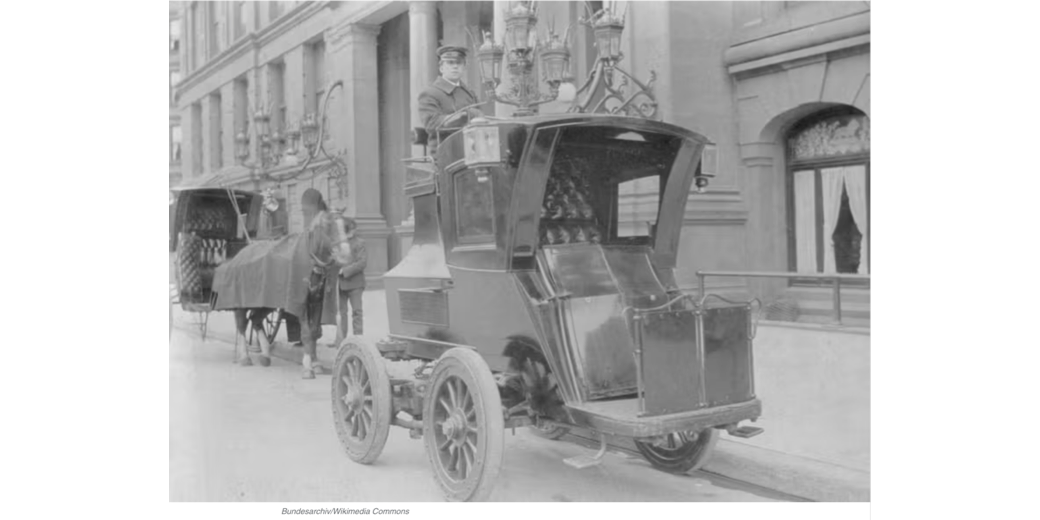
In 1899, a fleet of 100 electric taxis cruised the streets of Manhattan. When their batteries ran low, they pulled into a battery exchange station on Broadway to have their 1,300-pound lead-acid battery packs switched out in 3 minutes.
When electric cabs ruled New York’s roads
In the last years of the 19th century and first of the 20th, most of the cars made were electrics and steamers. Starting a gasoline engine required difficult and dangerous manual cranking, whereas electrics started with the turn of a key, and steamers by lighting a pilot light under the boiler and waiting for the pressure to rise.
Thomas Edison was deeply committed to the electric car. He saw the opportunity to sell charging services from his New York DC generation company. He invented the first home charging station and installed it in the garage of his New Jersey estate. He bought a Baker Electric to use in testing a new kind of wet cell Nickel-Iron battery he invented to replace heavier Lead-Acids.
Edison had some success. His Edison battery increased the range of Bakers and similar cars from 50 to 110 miles at their maximum 20 to 25 miles an hour.
His battery remains something of a marvel. It doesn’t wear out, isn’t toxic, is resistant to overcharging, and can be refreshed simply by rinsing out with water and replacing its electrolyte.
Some of the original batteries his company produced were still functioning more than 100 years after first use. New versions with some improvements are now sold as long-term storage for solar and wind-generated power. But even though they’re lighter than lead-acid and better at holding and delivering a charge, Edison’s batteries are simply too heavy, and produce far too little power per pound, to be useful in a modern car.
Thomas Edison’s Nickel-Iron Batteries
In 1912, Cadillac unveiled the electric self-starter. The death of a man who was struck in the head with the crank while manually starting a stalled Cadillac led to the self-starter’s invention — immediately erasing the ease of starting advantage both electrics and steamers had over gas cars.
The Accident that Started it All
Had the self-starter not been invented, perhaps Edison and others would have continued improving electrics. But as Ford and later General Motors were cranking out cheap gas cars by the millions, and lowering prices every year, there just wasn’t any market for expensive electrics offering less performance and range.
Gasoline delivers 488 times as much power per kilogram as a lead acid battery and 81.33 times as much as modern Nickel Cobalt Manganese Lithium Ion. A large part of the energy from burning gasoline is lost to inefficiency, but even so, the best gasoline engine delivers 26 times the motive power as the best EV.
It’s difficult to show that in real life, but I’ll try here by referencing the 2025 Mini Countryman 4WD, a car that’s unusually available as either an EV or gas powered car.
The gasoline version weighs 3,777 pounds. Its 14.3-gallon tank provides a range of 386 miles at 27 mpg combined. www.edmunds.com/…
The EV at 4,588 pounds is 811 pounds heavier. Its 65.7 kilowatt hour Nickel-Cobalt-Manganese Lithium Ion battery, the lightest and most power dense currently available, provides only 200 miles of range – possibly because it’s pushing 811 extra pounds down the road. www.motortrend.com/…
Is there a different type of EV battery on the horizon that could improve the Countryman’s range? Not likely, as the NCM Lithium Ion is the most energy-dense available. New battery tech is more about reducing cost and increasing charging speed and safety than adding energy density.
Many EVs are now being manufactured using lithium iron phosphate batteries. LFP batteries aren’t as power-dense as NMCs, so at the same weight, they’ll deliver less range. However, they’re non-combustible and can sustain as many as five times the charge cycles. Chinese battery manufacturers have improved the energy density of LFP batteries, but more importantly, they’re focused on compensating for shorter range by taking advantage of their ability to charge faster and cooler.
BYD vs. Tesla: Who Wins the EV Battery Battle?
Do Lithium Iron Phosphate Batteries Catch Fire?
Where LFP batteries won’t burn, NMCs are filled with a combustible liquid electrolyte, which provides its own oxidizer and is all but impossible to extinguish.
In 2021, a Li-On battery that entered Tulsa’s recycling flow caught fire at, and destroyed the Mr. Murph processing center, causing $7 million of damage. Mr. Murph was offline for a year, and all Tulsa area recyclables went to the trash-to-energy plant. www.newson6.com/…
You’ll find a link in the show notes to a video that’s humorous only because no dogs or people were hurt. It’s from a security camera that captured a dog in Tulsa treating a Li-On battery pack as a chew toy, and sparking a fire that ignited its home.
So what’s new?
There’s a lot of talk about solid state, and in batteries that doesn’t mean transistors but dry or gel electrolytes that reduce the danger of NMC’s liquid. A couple of companies have announced trial production, but don’t expect commercialization soon. It isn’t clear if these solid-state batteries would just be safer or also attempt to add density.
Chinese company CATL recently announced it has put a sodium ion battery into production, completely replacing expensive and rare lithium with common salt. CATL claims the sodium battery is about as energy-dense as LFP, can hold up to 10,000 charging cycles, and functions well at -40 Celsius. www.batterytechonline.com/…
BYD, the largest electric car company in the world, has announced Megawatt charging, delivering 1,000 kilowatts of power at 1,000 volts, which can add 250 miles of range to a compatible car in just 5 minutes. insideevs.com/…
Finally, in a back to the future moment recalling those 1899 NYC taxis, Chinese EV manufacturer NIO is pushing robotic battery swapping stations that enable car owners to buy cars without batteries, then subscribe to batteries as a service, even upgrading temporarily to larger batteries for a road trip.
Nio battery swap video the Netherlands
Sadly, there’s no sign that tech may reach the US.
The opposite seems to be happening as Tesla has started making its battery packs a structural part of its vehicles. That’s affirmation of how reliable and durable EV batteries are, but no consolation to those owners who have problems after warranties expire or whose cars are in wrecks bad enough to damage the battery.
Canadian driver Kyle reported through the Motormouth YouTube channel that some road debris scratched but apparently didn’t structurally damage the NMC Lithium Ion polymer battery pack of his Ioniq 5 and his insurance company totaled the car because Hyundai wanted an extortionate amount for a replacement battery — and his carrier surely didn’t want to take the risk the battery pack in his car would replay Mr. Murph’s expensive demise.
- $60,000 to replace battery. The battery costs more than a brand new car!
- $60,000 to replace battery // 2nd IONIQ 5 case confirms battery price!
So, thanks for listening if you made it this far. That’s a wrap for what I’ve learned about EV battery tech in mid-2025, but it’s changing fast, and mostly in China. I just wish it were easier to sift out the hyperbole, to know what’s good, and what’s too good to be true.
Thanks for the nice easy read with great citations, George!
I was not aware that our Tesla’s CATL battery was not combustible. That’s comforting.
Enjoy today. All smiles! ☀️
Let me connect some dots from my research assistant’s comment:
And from that my research assistant’s comment makes sense that HIS Tesla CATL battery is not combustible.
As to what battery is in your Tesla, there’s a trope I come across in a lot of novels, “it’s complicated.”
In general, the less power dense and more safe LFP batteries Tesla acquires from CATL go into Teslas made in China. Tesla sells a lot of cars in China, and exports from China to SE Asia, Australia, Europe, and more. Where some of those cars go, usually the lower range, lower performance, cheaper ones, go LFPs.
Tesla recently was in the news for buying the (used?) working parts of a CATL LFP battery plant so it could start building LFP batteries in Nevada. The output will be fairly small so tt is assumed that those LFP batteries won’t be used in Tesla cars but in its offline power storage products. Which would you rather have in your house, a Li-On pack that’s very safe but if something goes wrong, it goes very wrong, or a larger but safer LFP pack with many more years of recharges?
As to what’s in YOUR Tesla, your Tesla will tell you. There’s a battery sticker. Info’s available through your Tesla’s screen. Details in this article from findmyelectric dot com
Tesla Batteries: What Kind of Battery Does My Tesla Have?
And from the article, if that’s too complicated, “ask a Tesla Service Center Technician.”