
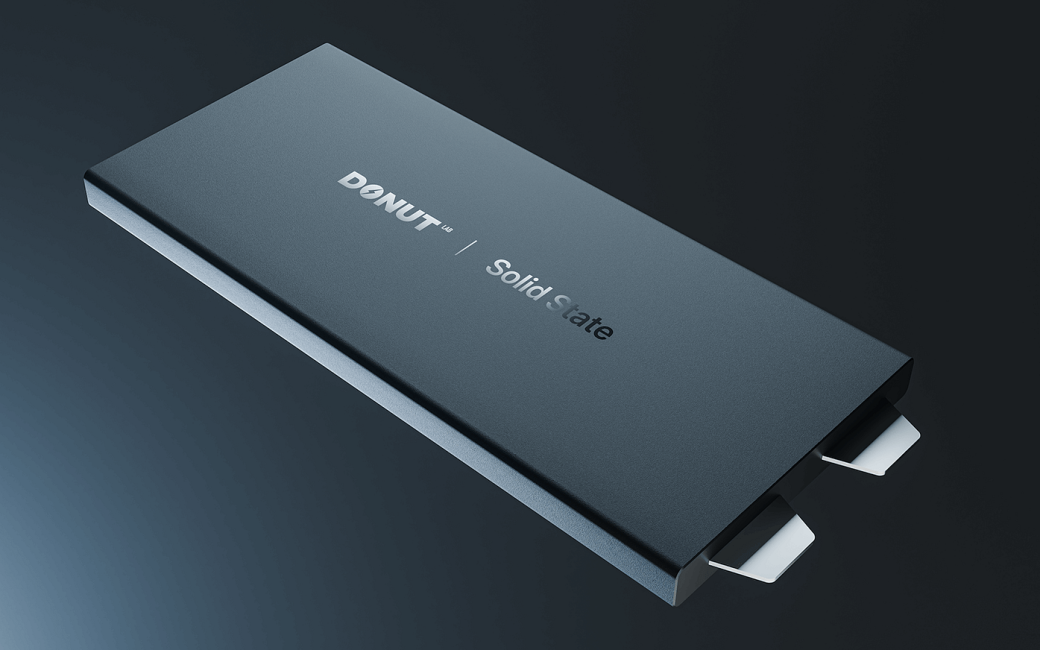
Steve Sheridan interviews Marko Lehtimäki, Co-founder and CEO of Donut Lab, about their production-ready solid-state battery designed to integrate into several platforms and applications.
The Donut battery has a high energy density of 400 Wh/kg and can support 100,000 charge cycles. Due to its solid-state design, it is extremely safe and low cost when compared to liquid electrolyte batteries such as lithium-ion.
Marko showed the Verge TS Pro motorcycle, which includes the Donut battery that powers a Donut rim motor. The frictionless rim motor drives the rear wheel and delivers high efficiency, power, and torque. Using the Donut battery and motor, the TS Pro provides 737 lb-ft of torque, achieves 0 – 60 mph in 3.5 sec, and has a range of 370 miles on a single charge.
Marko also showed the WattEV ultra-lightweight skateboard platform that incorporates Donut motors and solid state batteries. It is a modular platform that supports multiple vehicle types and includes an aluminum architecture, integrated motors, inverters, software, and battery.
Learn more at https://www.donutlab.com/
Using a Screen Reader? click here
Transcript of Interview
Steve
I’m here with Marko Letimachi at the Donut Lab booth and I heard an announcement yesterday by your company that was just fantastic and I’m very interested in your technology, so I’d like, if you don’t mind, for you to explain a little bit of how it works when incorporated into this Verge motorcycle.
Marko
Sure, yeah. So Verge TS Pro uses already our motors here, so it’s an in-wheel motor, it’s a rim motor, what we say, how we call it.
Steve
I heard the term hubless.
Marko
Yeah, it’s hubless rim motor. So it’s normally you have in-wheel motor in the hub, this is, you know, in the rim, and that gives so much more power and torque to the motor because the materials are in a larger radius. And so this motor right here produces thousand newton meters torque.
Steve
Newton meters, yeah, and up to 200 horsepower in our ultra model in a relatively small machine. That’s a lot of horse. Can I ask a couple questions about how this is implemented? So the point of rotation is between this and this?
Marko
Yeah, so stationary part is here, and then the rotating part is this.
Steve
Exactly, yes. So and now, is there any physical point of contact between those two pieces or is it magnetically separated?
Marko
Yeah, it’s magnetically separated. There’s no physical friction. There’s magnetic friction, but no, yeah, no physical friction.
Steve
Yeah, which also helps with performance, right?
Marko
Yes. And so this is an extremely efficient design, I would say, plus instant torque and high power. Yeah, I mean, so this is approximately three times more torque and power than the per kilogram, so power density and torque density versus the next best motor in the world.
Steve
So on a motorcycle?
Marko
No, period, like anywhere.
Steve
Yeah, impressive. Okay, yeah, so I see these three large electrical cables coming out. They’re providing electricity to the motor?
Marko
Yes, absolutely.
Steve
So the battery is up front here?
Marko
Yeah, battery is this whole bottom part of the vehicle, so you don’t need to make space for motor and everything because the motor is in the wheel, so we can use the entire space for battery.
Steve
Okay, can we talk a little bit about the battery technology?
Marko
Yeah.
Steve
How many kilowatt hours does that battery store?
Marko
There’s two variants. There’s this variant that is 20 kilowatt hours, and then there’s a 33.3 kilowatt hour variant that was announced just yesterday, which is 350 miles of range.
Steve
Yes.
Marko
On a single charge.
Steve
Yes, got it. Okay, it’s solid-state battery?
Marko
Well, yes. I mean, this is officially the world’s first vehicle shipping to customers that has solid-state battery in it. And that allows us not just to give almost double the range. Verge broke the Guinness World Record last year with the longest range on a motorcycle. Now they are almost doubling it thanks to our solid-state battery, but also that provides Verge’s bikes with less than 10 minute charge time, zero to full, versus the industry-leading 35 minutes that it used to be before, which was already way more than the competitors. Now it’s down to less than 10 minutes. And on top of that, the cycle life that is normally cars maybe 2,000–3,000 cycles, this is 100,000 cycles, so that’s like probably 30 lifetimes of a motorcycle. So you never have to worry about babying the battery or worrying if you can let it go to 100% or zero. It doesn’t mind. You can do whatever you want, charge it to full, let it go to zero as many times as you want; it doesn’t degrade.
Steve
This is very impressive. Let me ask a couple practical questions and then get into the battery tech. Practical questions: when you charge, what are you charging from or on?
Marko
Yeah, it’s NACS, in the US.
Steve
Like you can go to a Tesla charger?
Marko
Absolutely, yes.
Steve
And it will accept charge from a Tesla charger?
Marko
Yes, absolutely.
Steve
Got it. And so what is the max rate it will charge in kilowatts?
Marko
I think it’s somewhere around 200, 200 kilowatts.
Steve
Okay, that’s like a Tesla.
Marko
Yeah.
Steve
Yeah, that’s fancy. With that rate, you go below 10 minutes.
Marko
Yeah.
Steve
That is impressive. Okay, now the battery technology is solid-state?
Marko
Yes.
Steve
And you’ve announced some power densities that are incredible.
Marko
Yeah, not just… I mean, so if I run through the specs quickly, we have 400 watt hours per kilogram, we have full charge on the cell level, we can get to five minutes. So then it depends on the cooling and everything in the battery pack whether you get to five or ten or whatever, but five minutes is the fastest charge possibility. As mentioned, hundred thousand cycles, so that’s ten lifetimes of a car as well. And the other incredible things are that, of course, with motorcycles you don’t take them to deep freeze or anything, but if you’re using these batteries in cars, even at like 25 or 30 minus Fahrenheit, it will have 99% of capacity even.
Steve
So the reason you can do that is there’s no liquid.
Marko
Exactly, all solid-state. Yeah, so 200 Fahrenheit to minus 30 Fahrenheit, it’s 99 point something capacity.
Steve
That is impressive. So do you have to precondition the battery like a car might?
Marko
Not at all. And actually what we’ve done even is that normally you cannot get lithium-ion batteries to zero, right? We know about that; five percent is a lot of us, we like to go. Yeah, this can go 0.0, point zero.
Steve
And the battery doesn’t get damaged?
Marko
No. Then you can go, it’s 5C charging from the next moment without warming it up or anything. It just takes it like nothing.
Steve
Wow.
Marko
So yeah, absolutely.
Steve
200%?
Marko
And that does not harm the battery for consistent charging to 100,000 cycles with that, yeah. So that’s the difference also between lithium-ion and other technologies in solid-state. Not with all solid-state, but with ours, yes.
Steve
Yes. And can you say a little more about your solid-state technology or is it all proprietary? What makes it so special?
Marko
I could tell you, but I’d have to kill you, so this podcast is not worth it. So no, we’re not sharing about the chemistry. We do have our trade secrets about the manufacturing techniques as well as the materials. Of course, obviously some will soon, you know, when they get one of these into their hands, they will sweep and do some analysis and everything, but that can happen then. But right now we’ve decided, you know, we are the first, we are moving fast, we don’t want to share all of our trade secrets to all the competitors immediately.
Steve
I fully understand that and appreciate that. So with this really high power density and the solid-state technology, can you talk about the safety of these batteries relative to others?
Marko
Yeah, that’s the other thing, that there’s no risk of thermal runaway, so it won’t ignite. I mean, even if you shoot through it or do whatever you want to the cell, it will be just fine. It just loses the capacity from the area where you shot. But yeah, so there’s no risk. And that’s actually a huge thing, you know, not just for automotive, but we’re also putting these into grid storage and charging stations and all those energy storage places.
Steve
So home batteries?
Marko
Absolutely, yeah. This is going into all kinds of places now, so they’re not having to worry that it will catch fire. It’s a huge thing.
Steve
So we see this implemented on a motorcycle and you’re working with Verge to do that. Are there other vehicles right now that you’re working on?
Marko
Actually, Watt Electric, they provide this skateboard platform, 200 plus OEMs already. They do commercial vehicles, sports cars; it’s a modular skateboard platform for car manufacturers. It comes now with Donut motors and the solid-state battery since today. So any of the customers of Watt that want to utilize this technology, they can do a drop-in replacement to the existing cars.
Steve
Got it, fantastic. So it sounds like your goal is to get into as many platforms and other uses as possible.
Marko
Yeah, I mean, it seems we cannot help it because last year we announced this incredible motor family and we got like 500 OEMs talk to us throughout the show, five days. Now, before we started today at 9 a.m., before the show even started, we had over a thousand OEMs that had reached out to us already after yesterday’s announcement. So it is going literally to data grids balancing, to charging stations, to marine, to drones, to everywhere, and we’re happy to do business with everybody.
Steve
I love to see this kind of technology proliferate and I’m glad you guys are out front. Is there any question I didn’t ask that you’d like to get information out about your product?
Marko
Maybe capacity, because a lot of people wonder like, okay, when can you go to big scale or whatever. So we are already at gigawatt hour level. We are going to tens of gigawatt hours next year, and if any large OEM needs even more capacity, we can ramp up and there’s basically no ceiling to our ability to ramp up. So the bigger the project, the happier we are, so we’re happy to work with everybody.
Steve
Fantastic. Marko, it’s been a pleasure and I appreciate the time you spent with me today, and good luck, all the best with this. I’d like to see you succeed.
Marko
Thank you so much.