
Allison interviews Souhail Alaoui from Vaonis about their line of smart telescopes designed to make astronomy accessible to everyone. All Vaonis smart telescopes deliver accessible deep-sky astrophotography without manual alignment or traditional eyepieces.
On the show floor is Vaonis’ Hyperia smart telescope, which serves more as a smart observatory. It is a high-end telescope designed for automated, professional-quality astronomical imaging. It combines a large 150 mm refractor with precision optics and a full-frame sensor to capture detailed deep-sky objects with minimal manual setup, all controlled through a companion app.
Built for observatories, institutions, and serious enthusiasts, Hyperia includes direct-drive tracking, field derotation, and long-exposure automation for continuous observation and imaging. It is positioned as a premium, turnkey digital observatory rather than a consumer hobby telescope.
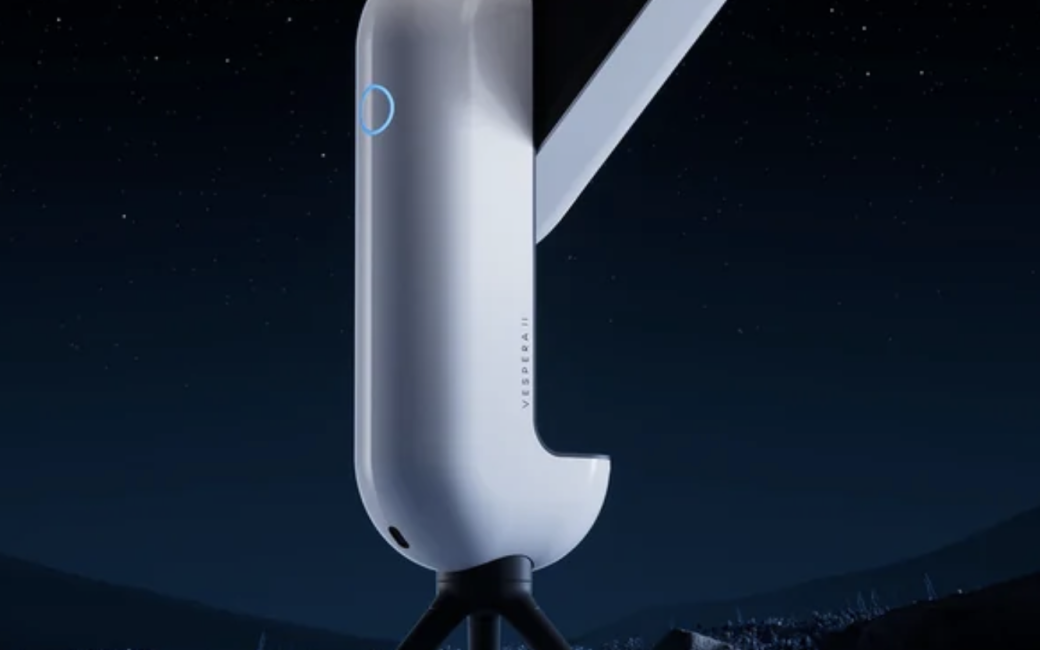
Souhail also mentions Vaonis’ more affordable, consumer-oriented telescopes, including the Vespera, a compact, app-controlled smart telescope that automatically locates, tracks, and captures wide-field images of the night sky.
Learn more at https://www.vaonis.com/
Using a Screen Reader? click here
Transcript of Interview
Allison: Steve and I are big fans of space. We’re big fans of telescopes. We have a smart telescope at home, but when we saw this white telescope flying around, changing position, like I’ve never seen anything go with the slew rate that this has, we had to stop and talk to Souhail Alaoui about whatever this is. Tell us the name of the product and the company.
Souhail: Hi, thanks. Nice to meet you. So, our company is called Vaonis. So, we invented this first smart telescope 10 years ago, which was called the Stellina, which paved the way like to a lot of other telescopes on the market right now. And with this new telescope, we are creating a new era for these kind of smart telescopes and it’s almost what we call a smart observatory. So, it’s an all-in-one system that we have like co-engineered and co-produced with Canon. So, it has a full optical system with Canon and even the sensor is provided by them to provide like the best crisp pictures of the of the night sky. And with this product, the idea is to provide something for institutions and for people in the outreach like planetariums, observatories, people working on the sciences and etc. for astronomy.
Allison: So, I’m going to describe a couple of things here because this is also audio. Uh what what we’re standing in front of is a white cylinder that’s almost as tall as I am and then another white cylinder that’s rotating in in elevation and azimuth, it’s flipping and flying around.
Souhail: Exactly.
Souhail: So, the first cylinder, so it’s the static one, the one that doesn’t move, that it’s what we call the mount. So, even in traditional astronomy, you always have a mount. So, which so which is like the thing that will hold your telescope. And the other arm, what we call the arm that is moving everywhere and that’s pointing the sky, it’s the the one that’s it’s including the refractor. So, inside you have all the optical system. As you can see, you have seven here, if you zoom in, you can see the 17 lenses like stacked right there.
Allison: Wait, let me count them. One, two, oh, okay.
Souhail: Good luck. And and behind these lenses, we have a camera. So, this full frame camera will provide you like a huge resolution of the things that you can get and all the light that is gathered with all these lenses will provide you pictures of different like almost 50 megapixels resolution.
Allison: And how big is the aperture on this?
Souhail: So, it’s 150mm. So, in inches, it’s something like uh Oh, let him do it. 5.9.
Allison: Five 5.9 inches.
Souhail: 5.9. Yeah, so let let’s call it six.
Allison: Okay. So, now uh the way this works, you’re never you aren’t ever looking through uh an optical uh
Souhail: Exactly. You have no IPs.
Allison: Radical.
Souhail: With these kind of products, we have no IPs because we provide it with um how do you say? We provide it with an app and everything is controlled from the app. So, all you have to do is like you have a catalog of objects. So, you point the object you want. So, you click on it and the telescope will recognize itself where it is and the places you where you are placed. It will recognize the sky pattern and will know in which direction it has to go to find like the object you want to point.
Allison: So, I tell it I want to go to the Orion Nebula, of course I do. And so I’ve tell it to go there and then does it does it do image stacking?
Souhail: Exactly. It does the stacking automatically. So, you can have what we call the live observation because it will stack images like the the more time you give it, the the best images you will get because you will gather more light and which which means that you will give like uh more details to your image.
Allison: It’s not actually more light, is it? It is because you’re stacking, you’re removing you’re removing noise and and and
Souhail: Exactly. We’re removing noise around all the aberrations, etc. So, you will get better quality of pictures. And also with this kind of system, you can like stack images overnight. So, for example, you if you stop a session like tonight and you you will have like a free slot of clear sky like in two weeks or something, you can resume your observation and it will stack over what you have done like two weeks ago.
Allison: Wow. Oh my goodness, that’s crazy.
Souhail: That that’s crazy and we are like the only company providing something like this. It’s a feature that we have developed like we made it took us a lot of time to do this, but it’s really a game changer because the more you stack, the better results you you get as you know as you are a fan of astronomy. And it’s the thing that allow us to get results like this.
Allison: So, we’re looking at an iPad right now with uh I’m sorry, let us move the CES Innovation Award out of the way. Oh, oh darn, we have to point at that. Sorry. Oh my gosh. What what uh what is that we’re looking at on the screen?
Souhail: So, so here what you can see is the elephant trunk nebula. So, if you zoom in, you can see the details here. You can see like the the ear, you can see the trunk, you can see all the details here. So, and we can still zoom in, I think, to see even more details and you can see some stars appearing beneath it, etc. So, that it’s it’s really cool. It’s really impressive.
Allison: Very nice. Oh my goodness. Gives you an idea of the resolution of the screen, right? Do you want to zoom in again, Steve? Did you see it? Wow.
Souhail: And for people working on the outreach, etc., it’s really a game changer because you don’t focus on setup and you only focus on the outcome and and the the share of knowledge because you you spend less time like fixing things, adjusting details, etc. But you you you all you have here is the the full wonder of space. So, it’s really easy, really really intuitive and really impressive by the results.
Allison: Yeah, I do find at first I thought uh with our telescope, it’s nothing near as cool as this, but with ours I thought well, I’m not going to be looking through the the optical you know radical. That that isn’t going to be like I didn’t really see it, but then when I got to see it grow as the images get stacked, it’s a it’s an overwhelming feeling of like I’m looking at that. I’m really, really looking at that. And you’re capturing it because it doesn’t matter if you can’t prove to somebody you saw it. So, it’s good to capture it.
Souhail: Exactly. Yeah, especially and you can share it, especially. Our baseline in the company is share your universe. When you have something like this, you can see it on your iPad, but you can share it with people like with mirror casting on a TV screen or uh on a scene or something like this. So, you can share astronomy with people and you can make it easy because even if we even if you have an IP, you can’t see the same details and you can you can get you cannot get as much details as you can get with something like this. And even with the colors, etc. You can see like black and white pictures, but not with this kind of details and the the true tone.
Allison: This is fantastic.
Steve: One thing we’ve noticed is that and we live in Los Angeles, so viewing is horrible. But with stacking, we can actually get some images out of this.
Souhail: Exactly. So, so with the stacking, you can reduce the noise in in the first place. And especially we have accessories like light pollution filters that you can place on your telescopes and it remove all the light that is not necessary to add to your image. So, it will remove it and will keep only like the lights coming from the space and not not the lights polluting your area like with the external lights, street lights, etc. So, so that that’s really cool.
Allison: We’re all street lights.
Souhail: So, you can start even from the city. So, you don’t need to be on like on the countryside to to see something like this.
Allison: I think that’s important because it makes it accessible to people who don’t live in people always say, oh, hey, there’s this great meteor shower, just get in a dark sky area. It’s like I live in LA, that’s three and a half hours from my house.
Souhail: And you need to get everything, you need to pack all your stuff and the heavy material, etc. to put it on the to drive there and to set everything and you almost miss the peak. And that’s that’s why we call it like, okay, forget the hassle and just enjoy your time and like focus on the wonder of the sky. So, it’s that’s our mantra.
Allison: That’s that’s perfect. So, one more time, the name of the telescope is?
Souhail: So, the telescope is called Hyperia. So, it’s the more advanced telescope in our range, but we have like uh telescopes that are accessible like for all the consumers that the range is called Vespera. And they are already available on our website and you can find it even on distributors over the US and everywhere else.
Allison: Where’s the website? You’re going to spell that for us? That was a test. Okay, good. He’s got it. We’ll get it on his card. But this this is fantastic. Very good. Anything that promotes promotes science, we are all in. So, thank you very much for your time.
Souhail: So, it’s vaonis.com. So, so V A O N I S.com. Vaonis, V A O N I S.com. You’re welcome. Our pleasure. Thank you. Our pleasure. Thank you for having me.
[…] CES 2026: Vaonis App-Controlled Smart Telescopes […]