
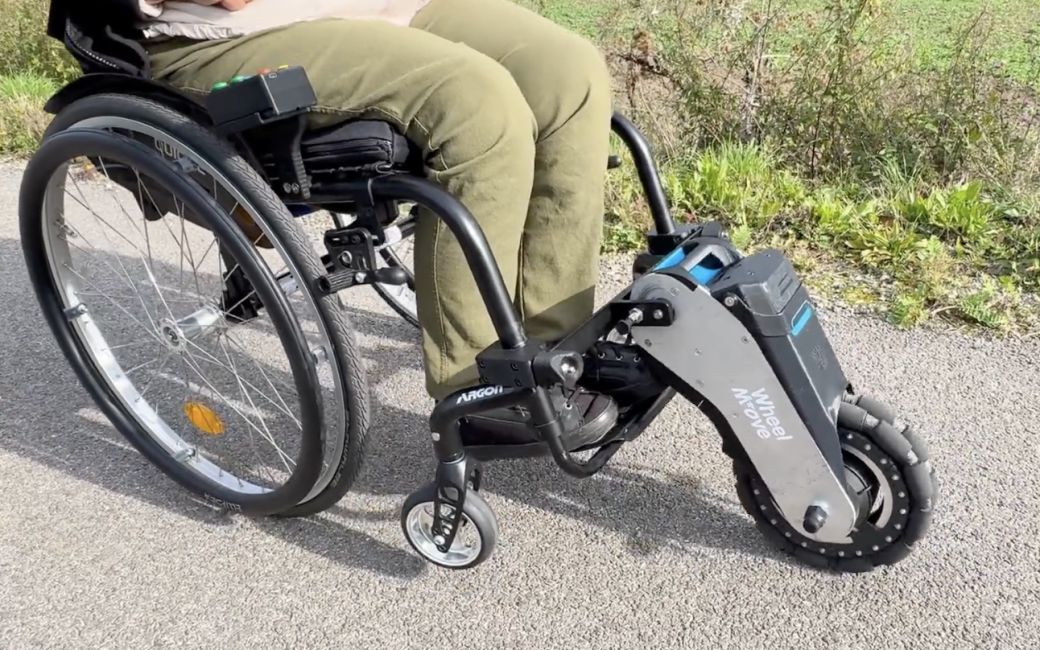
Allison interviews Aumaury Dupas and Kevin Surbled, CEO and COO of WheelMove, respectively, about their powered wheel system that attaches to manual wheelchairs, making them easier to push and maneuver. It integrates with many standard wheelchair frames to provide additional propulsion assistance without replacing the entire chair. The device aims to reduce the physical effort required by caregivers or users, especially on inclines or longer distances.
The system typically includes a motorized wheel that can be engaged or disengaged as needed, allowing users to switch between assisted and traditional manual mobility. Controls are usually intuitive, enabling smooth transitions and speed adjustments for different environments. This design supports independence while maintaining the familiar feel of a manual wheelchair.
WheelMove’s lightweight, compact build emphasizes portability and convenience. It can be attached or detached quickly, making it suitable for daily use, travel, and varied terrain. The product enhances overall mobility without significantly increasing the wheelchair’s bulk.
By offering powered assistance, WheelMove helps reduce fatigue for both users and caregivers. It supports greater confidence in navigating diverse settings, from urban sidewalks to recreational paths, improving accessibility and quality of life for wheelchair users.
Learn more at https://www.wheelmove.eu/
Using a Screen Reader? click here
Transcript of Interview
Allison: I’m going to try to interview two people at once, which is going to scare me here, but I’ve got Kevin Surbled, who’s sitting in a wheelchair here, and I’ve got Amaury Dupas, who is also going to help me understand what we’re looking at here.
Kevin: Correct.
Allison: And my understanding is that this is a mechanism you can attach to any wheelchair and it becomes a motorized wheelchair and more. Would that be a correct way to describe it, Kevin?
Kevin: So, this is WheelMove. This is the first compact and lightweight solution on the market that enables, as you said, to transform any manual wheelchair into an off-road with electrical assistance wheelchair. Let me show you.
Allison: So, I’m going to describe it for the audio only folks as well. So, he’s got an attachment on the regular wheelchair that he’s just pulled out of two pins and he’s lifting up a mechanism with a wheel on the front of it.
Kevin: Yes. And you can see it’s very lightweight, not heavy.
Allison: He’s picking it up with one arm, one hand.
Kevin: Yes.
Allison: And can I see how heavy it feels?
Kevin: Yes. Please.
Allison Oh man, you’ve lifted that easier than I did, but it’s liftable.
Kevin It’s 8 kg, so 16 lbs.
Allison: Okay.
Kevin: So, then you can put it on your wheelchair like this in a few seconds. It’s installed. And then you turn two buttons, you put the brakes. And you have a remote control. You push one button like this, and then it lifts up automatically and effortlessly the caster wheels. And now you can go on difficult terrains.
Allison: So, a normal wheelchair has two big wheels and two front little caster wheels. The caster wheels are now off the ground and he’s on kind of a rugged bigger tire in the front, a single tire, right?
Kevin: Exactly. And now you can go on difficult terrain like grass, cobbles, and so on, without difficulties. And you can press another button on the remote control and you can go with an electrical assistance to go everywhere you want.
Allison: So, you’re going to press go. Oh, I’m going to be chasing him now. All right. No, no, this is good. This is great. So, it’s going forward, but you’re still controlling the positioning, the direction with your hands on the wheels.
Kevin: Yes. I use the manual wheelchair as I use my wheelchair usually. So, I keep the direction with the hand rims, the big wheels on the sides. And then I can go everywhere I want.
Allison: And then when you want to stop, you hit the stop button.
Kevin: You hit the stop button. I have several buttons on the remote. I can go up to 10 km/h with different speeds and I select the one I want depending on how fast I want to go.
Allison: Very cool. It seems to me like it would be a little bit of work to be ready to go, stop, go, stop with buttons.
Kevin: Well, it’s a habit, I would say, but it’s very easy to take in hand. We make it used by people who didn’t know at all WheelMove and in a few minutes they were able to use it very easily.
Allison: Okay. So, you’ve got a couple other buttons. So, you had the lifting off the caster wheels, you had for go and stop. What else do we have?
Kevin: We have the on off button. We have the plus for forward direction, reverse direction, and plus minus speed. So, I press one time, two times the plus button and I go first speed, second speed up to five speeds. So, I adapt my speeds to my environment. I want to go fast, I go fast. I want to go slowly, I push only one time, for example.
Allison: Okay, let’s drive back here because I have more questions.
Kevin: Okay. I follow you. So, let’s go.
Allison: I’m running in front of him here. Part of me was trying to remember if I set my backpack down, but that was good. So, what’s the is this a prototype or is this a production model? What are we looking at?
Kevin: So, what you see here is a prototype, but we are already preparing the serial parts that will be available in a few weeks and we’ll start the production in a few months in order to have the product available on the market by the end of the year.
Allison: Oh, fantastic. So, do you have a waiting list?
Kevin: Yes, we have already some customers that are waiting for this product for summer.
Allison: Very good, very good. If people wanted to learn more about WheelMove, where would they go?
Kevin: They go on our website, wheelmove.eu.
Allison: I’m sorry, I didn’t hear. WheelMove, so w h e e l m o v e.
Kevin: .eu.
Allison: .eu. Very good. That explains the accent. But thank you very much, Kevin. This is fantastic. This is a very interesting product.
Kevin: Thank you, Allison.
[…] CES 2026: WheelMove Makes Wheelchair Mobility Effortless […]
Iam in India but how purchase this product,
Iam physically challenged person i need this product
@kutti mani Have you tried going to the https://www.wheelmove.eu/en/order order site and clicking the Order button in the upper right of the page? Since you’re from India and the site appears to only support English and French, it may be more of a challenge for you, but presumably you speak English. I don’t know if WeelMove ships to India but give it a try.