Allison interviews Jack Walters, CEO and Cofounder of HapWare, about their wearable device called ALEYE, designed to help blind and neurodiverse users interpret nonverbal communication. Jack explains that the system combines AI, haptic feedback, and the Meta Ray-Ban smart glasses to detect facial expressions, gestures, and social cues in real time. Those cues are then translated into vibrations on a wristband in less than a quarter of a second.
During the demo, Allison tries on the wristband while different haptic patterns represented actions and emotions such as smiling, waving, nodding, surprise, and handshakes. The vibrations used directional movement and intensity to mimic the feeling of the gesture itself, allowing the wearer to distinguish different cues through touch alone.
Jack explains that users can learn about seven haptic cues in roughly five minutes, although the system currently supports more than 30 patterns. The design was developed through direct feedback from blind and neurodiverse communities, focusing on the gestures and emotional signals that users found most important in everyday interactions.
Jack also describes how the technology could benefit autistic users who may struggle to interpret facial expressions or emotional tone despite being fully sighted. He emphasized that the device is intended to provide information and context rather than direct instruction, helping users better understand social interactions independently.
Jack announces that preorders for ALEYE had just opened, with the first 1,000 units planned for shipment later in the year. The wristband was priced at $359, with an optional subscription tier for advanced AI features.
Learn more at https://www.hapware.com/
Using a Screen Reader? click here
Transcript of Interview:
Allison: HapWare is a company that has a product called ALEYE that is supposed to help blind people and people with neurodiversity. You can just explain what this is.
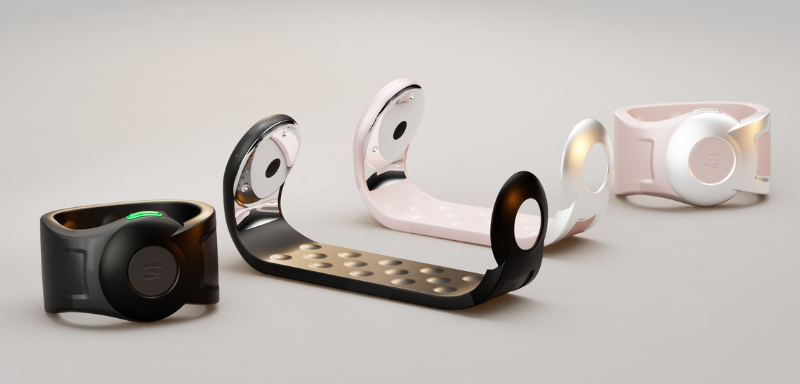
Jack: Yes. Thank you for having me. At HapWare, we build wearable technology for people who are blind or neurodiverse, and we give them access to all the different nonverbal and social cues, things like body language, gestures, expressions, and sentiment in real time using haptic technology and AI. It’s a wristband that has different haptic actuators around it, and it connects to the Meta Ray-Bans and can communicate everything end to end in less than a quarter of a second.
Allison: So your Meta Ray-Bans are looking at me, they see me smile, and then it’s going to give you some sort of input on your wrist?
Jack: Exactly. It sees you smile or it sees you make any other sort of visual or nonverbal cue, and then it converts that to the sense of touch, or haptics. We have demos right here if you want to feel the power of the haptic feedback so you can see what I’m talking about when you get that real-time access.
Allison: All right, I’m going to describe this as I’m doing it too because I always tell people we do video, but pretend the whole audience is blind, so describe everything, right?
Jack: Yeah. First off, the ALEYE wristband, which I’m going to put right here if you want to get this, is a small, discreet, almost watch-like form factor. It clasps magnetically to the top, and we have multiple different colors. We have a nice rose gold. The one I’m holding right now is a navy blue one with an orange undertone. Then we have a nice matte gray one with a red little button.
Allison: You refer to it as small. I would call it wide.
Jack: Small and wide, yeah.
Allison: Yeah, it’s thin, but it’s wide on the wrist, wider than a normal watch band, but it looks like a cool watch band.
Jack: Right. It’s about 44 millimeters, so that is slightly bigger than your normal watch. That’s mainly to add the different haptic electronics in it. But we still are striving to keep it smaller and smaller. We actually just opened up our pre-orders yesterday, so very exciting. We’re going to be shipping a thousand units at the end of the year to the blind and neurodiverse community.
Allison: So inside of this wristband there’s some rubber bumps, is the way I would describe them. You’re telling me if I put my wrist in here, you’ll be able to teach me different emotions or things you’d see on somebody’s face.
Jack: Okay, let’s do it.
Allison: Okay, so I’m going to put my arm in. I’m basically just in a U-shaped thing that’s got these little bumps on it. He’s got an iPad where he’s going to show me different gestures, right?
Jack: Yep. This is our little demo build. We have mobile apps that connect to the wearables. I’m going to play a pattern right now. This is a smile or a happy face, so it gives a U sensation, right? It goes around and up, almost like recreating or drawing the expression or the emotion that someone would be showing you.
Allison: I’m surprised you can feel that much change. I thought that would be harder to feel.
Jack: Yep. So that’s like a smiling face. Now we’re going to do a wave. Maybe waves are inaccessible for people who are blind. This is a nice side-to-side motion. You can kind of feel it goes left to right, left to right, almost recreating that wave.
Allison: How about eye roll?
Jack: Eye roll? We do have eye roll. We don’t have a pattern for it right now, but I do have things like brows furrowed and jaw drop. So here’s a jaw drop or a surprise sensation. You can feel the patterns going up and down. Maybe you want to know when someone is walking away or turning away. We have patterns for that as well, which are playing. Maybe a head nod, right? Head nod.
Allison: Oh, that one’s really distinct.
Jack: Yeah, head nod’s really distinct. It’s like an up and down.
Allison: Do you have to train yourself, I would think, after a while to learn what does that mean?
Jack: Yes. We probably just played about seven cues. We learned that you can learn about seven cues in about five minutes, so it takes about five minutes to learn seven cues. We have over 30 of them, but we say start with seven. Start with the seven that really matter to you and then go from there. For instance, our co-founder Brian, he’s part of the blind community. He really likes the different gestures, people going up to shake his hand, walking away, their arms crossed.
Allison: Oh, handshake. That’s a classic one. It’s like, I don’t know, you’ve got your hand out.
Jack: Oh yeah, so we have a handshake pattern. If you want to, I’ll play it for you real quick. So then we have handshake, right? All these different gestures. The way that we come up with these is from talking to the community. People reach out or they use our technology, and we give them access to this stuff depending on what they want. Especially in the neurodiverse field, we want to be able to help them out because there are so many different sentiments that are important, and we want to make sure that we can get these sentiments communicated effectively and easily so that we can empower their lives.
Allison: So they might know the phrase eyes furrowed, but they don’t know what it means without maybe seeing those words, feeling that thing.
Jack: Yeah, so I’m glad you asked that. We have expressions and then sentiments, or emotions, you could say. Brows furrowed is great because that’s just your eyebrows moving together. But what does that mean? Well, it might be angry. So then we also have patterns for angry or sad or surprised or excitement. That’s usually what we’re communicating to people with autism, with autistic people, those different sentiments and emotions.
Allison: So that’s more effective to feel it than it is to see it for them.
Jack: Yeah, so over half of communication is nonverbal. For people that are autistic, they talk about the struggle to understand people’s emotions, and a lot of people are completely sighted. So what we learned is that to bridge that communication gap, we can use haptics and reinforce that learning to them. We can reinforce what that learning is while giving them full autonomy. We’re not telling them what to do. We’re just giving them the information so that they have it.
Allison: This is really, really interesting. So if people wanted to learn more about ALEYE, spelled A-L-E-Y-E, then where would they go?
Jack: Go to hapware.com, H-A-P-W-A-R-E dot com. We just opened up our pre-orders this week. We’re going to be saving a thousand spots, and you can order it for $359, so a very affordable price. We try to make things as accessible as possible. Then we also have another option for pre-order as well with the year paid subscription if you want some of the AI and advanced features. But hapware.com, you can learn all about us, or you can reach out to me at [email protected]. I answer every email from users or people with questions, so you can also email me.
Allison: Fantastic. And we will certainly see you at the CSUN Assistive Tech Conference in March.
Jack: Yeah. I can’t wait for part two of the podcast in March. Thank you so much.
[…] CES 2026: HapWare ALEYE Wearable Assistive Tech for Nonverbal Communication […]