
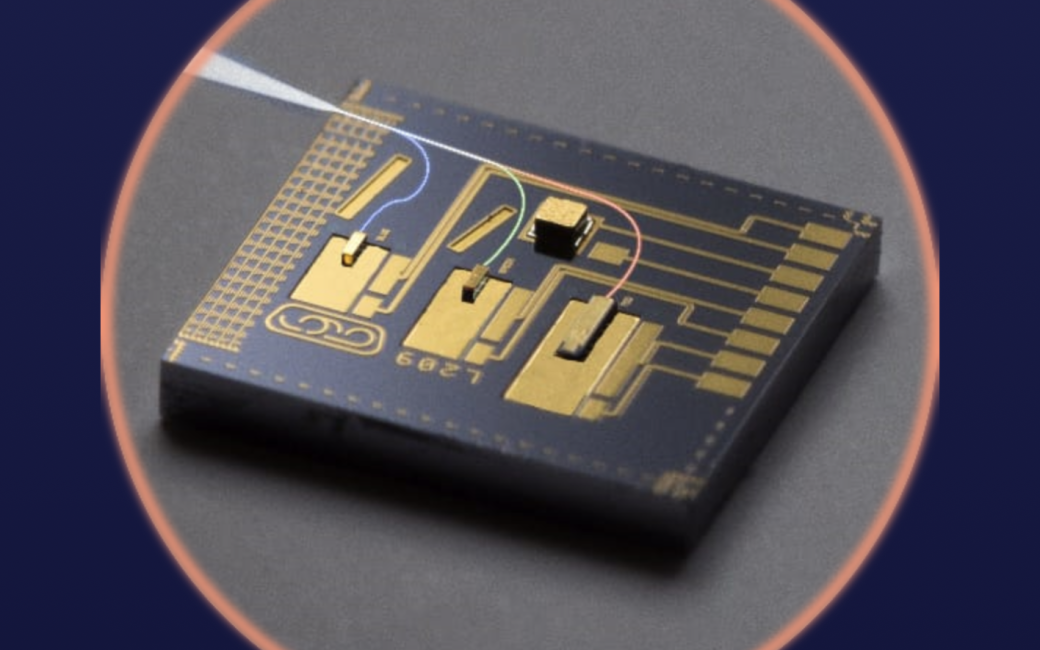
Allison interviews Brilliance co-founder and CTO Douwe Geuzebroek about the company’s development of a miniature laser system built on a chip for use in augmented reality glasses. The technology is designed to provide smaller, more power-efficient AR displays with longer battery life compared to conventional laser systems.
Douwe describes the company’s approach as “photonic integrated circuits,” a wafer-scale manufacturing method similar to how electronic integrated circuits are produced. Instead of relying on bulky lenses and mirrors, the system manipulates visible light directly on a silicon nitride-based chip using microscopic waveguides that function like optical fibers.
The chip itself is remarkably small — smaller than a fingernail tip — yet it contains a three-color laser system capable of generating the light needed for AR displays. By exploiting differences in optical properties between materials such as silicon nitride and silicon oxide, the chip can bend and direct light internally without traditional optical components.
The intended application is AR eyewear, where the laser projects images directly into the user’s eye to overlay digital information onto the real world. Douwe says the technology enables lighter, more compact glasses with improved energy efficiency, addressing two major challenges facing AR hardware today.
Learn more at https://www.brilliancergb.com/
Using a Screen Reader? click here
Transcript of Interview:
Allison: I’m with a company called Brilliance, and I’m talking to Dr. Douwe Geuzebroek. He’s got a laser system on a chip that he’s going to tell us about.
Douwe: Yes, indeed. This is a laser system on a chip for augmented reality glasses. Using lasers for augmented reality glasses is useful because it allows for longer battery life and longer use of augmented reality glasses. But making a laser system the normal way is very big and very tedious. Using wafer-scale technology, like integrated circuits, makes this less complex and also scalable into mass volumes.
Allison: So the technology you’re using versus what everybody else is using is what?
Douwe: It is called photonic integrated circuits. So it’s a wafer-scale way of making lasers on a chip.
Allison: Wow. Can you go a little deeper into that for me?
Douwe: Yes. We use a silicon nitride-based platform, which is a very common way in the electronics world. But in the photonics world, it is a way of manipulating visible wavelengths on a chip to do what you otherwise would do with lenses, prisms, and complex optical systems.
Allison: I actually understand lenses and optics better than I understand this. So just to describe to the people who are only listening, he’s holding a chip in his hand here that is smaller than the tip of my fingernail, and you’re saying that’s a three-color laser, a white laser, so it’s got all three colors, and you’re bending the light within that without using any mirrors or lenses.
Douwe: Yeah. That’s exactly what it does. We are using waveguides. You can see that as an optical fiber. People know optical fibers, but we make these optical fibers on a chip.
Allison: And you’re able to—how are you able to bend the light to get it to converge and diverge to change colors?
Douwe: We bend the light because it’s a waveguide. That’s because you are using multiple materials, silicon nitride versus silicon oxide, and you have an index contrast. That’s the way you can bend light, like you can bend a fiber. That’s what we do on the chip.
Allison: That’s really cool. So again, the application for this is to be in VR or AR glasses, where it’s tiny. What are they using the laser for in AR glasses?
Douwe: To be the light source for the display. In augmented reality glasses, you are augmenting an image on top of the real-life world that you see. For that, you need to make a display, and you can use this source as your source for light.
Allison: Okay, for a second there I thought maybe you’re talking about using it to look around the room, but you’re actually saying this is projecting on the inside of the glass.
Douwe: You are projecting a laser into your eye.
Allison: All right, so your company is from the Netherlands. Are you working with any manufacturers yet, or where are you in the process?
Douwe: Yes, so we are a startup company now, about three years old, and we work with all the major display makers and glasses makers to get it started. There was a time when people were wondering, will this come or will this not come? Well, you now see products coming, so it will come, and I think in the next couple of years people will use a laser for that.
Allison: So whether you understood every detail of laser technology or system-on-a-chip technology that Douwe was talking about, what you can look forward to is smaller AR glasses because of the work he’s doing here.
Douwe: Yes, smaller and longer battery life because it’s more efficient.
Allison: Oh, fantastic. Thank you very much. If people wanted to learn more about Brilliance, where would they go?
Douwe: They would go to our website, BrillianceRGB.com.
Allison: BrillianceRGB.com. Very good. Thank you very much, Douwe.
Douwe: Thanks.